Monday, September 25, 2006

Gluten Free BBQ Pulled-Chicken Recipe

Homemade Gluten-Free Pulled-Chicken / Pulled-Pork Recipe

My wife created this gluten-free treat for me: her own recipe for fantastic pulled-chicken (or pork), from scratch, that is just wonderful and full of flavor imparted from the peppery and smokey combination of poblano and acho peppers, and even some gluten-free beer!  I find it quite excellent served alone as a main course, or served on corn tortillas with avocado, tomato, sour cream, salsa, shredded lettuce, etc. - for a SouthWestern style treat (a great way to serve any leftovers).

Homemade Barbecue Pulled-Chicken 

The Recipe

I placed the recipe inline (below), or you can also get it from our cookbook website recipe library here: homemade gluten-free pulled-chicken / pulled-pork recipe; substituting a pork roast for the chicken is quite simple.

Pulled-Chicken Ingredients:

2 Tablespoons Olive Oil
4 Chicken Breasts (boneless/skinless)
6 Chicken Thighs (skin & fat removed)
½ Tablespoon Ancho Chile Pepper Powder (increase to ¾ tablespoon for really spicy sauce)
½ Teaspoon Black Pepper
1 Teaspoon Garlic Powder
½ Cup Buffalo Wing Sauce*
1¼ Cup Vegetable Broth*
½ Cup Sorghum Beer
5 Garlic Cloves (remove paper skin but leave whole)
1 Medium Onion (quartered)
1 Poblano Pepper (whole)

*Note – used:
  • ½ Cup Anchor Bar (Frank & Teressa’s) – Buffalo Wing Sauce / Hotter Recipe. Label on bottle states gluten free.
  • 1¼ Cups Kitchen Basics Natural Vegetable Cooking Stock. Label on container stated gluten free.

Homemade Honey BBQ Sauce Ingredients:

3 Tablespoons Tomato Paste
4 Tablespoons Honey
2 Tablespoons Sugar
1 Tablespoon Molasses
1 Tablespoon Apple Cider Vinegar
½ Cup Water
½ Teaspoon Ground Mustard
1 Teaspoon Garlic Powder
½ Teaspoon Onion Powder
¼ Teaspoon Black Pepper
½ Teaspoon Cayenne Pepper (increase to 1 teaspoon for really spicy sauce)
½ Teaspoon Chili Powder (increase to 1 teaspoon for really spicy sauce)

Directions:

Preheat oven to 325°.

Create Honey BBQ sauce by placing all ingredients in a large bowl and mixing together.

Prepare chicken by removing skin and any excess fat. In a large cast iron Dutch oven (or other large stovetop and oven-safe pot with lid), heat oil on stove-top. Place chicken in bottom of pot. Sprinkle ancho Chile pepper powder, black pepper and garlic powder over exposed chicken. Allow chicken to brown on one side (takes a few minutes); flip chicken and repeat, allowing other side of chicken to brown. Add remaining ingredients, including the Honey BBQ sauce you created, and stir.

Place lid over pot and carefully move to oven (pot is extremely hot). Allow to cook until chicken is tender and falls off the bone, approximately 2½ hours.

Remove from oven. The chicken should look like this:
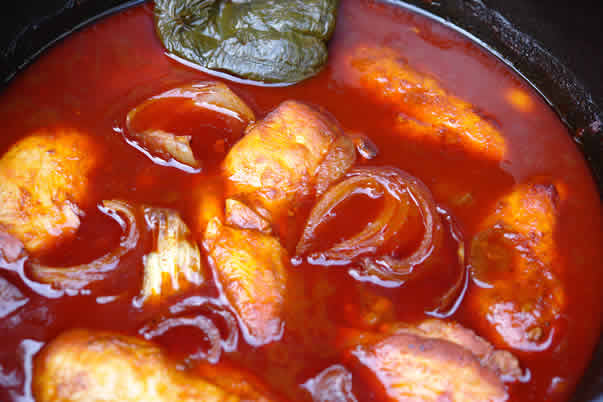
Cooked Chicken, spicy and ready to be shredded.


Discard the onion, poblano pepper and garlic. Remove chicken pieces from pot (reserve juices) and shred using two forks; discard bones. Place shredded chicken in serving bowl and cover with reserved juices; serve.

Your end product, the pulled-meat dish, should look something like this:
Homemade Barbecue Pulled-Chicken

And there you have it: Gluten Free Barbecued Pulled-Chicken. We also make a pulled-pork dish that is quite similar in strategy and recipe. If anyone finds it necessary, I will try to note the differences at some time and post that too, but if you have selected a pork-roast for slow-cooking in the oven before, it is rather straightforward substitution. Hope you like this recipe!

Continue to read this Gluten-Free Blog for all sorts of gluten-free recipes, product-reviews, and related information. In addition, visit my Gluten-Free Recipes Site where many of the recipes I have featured on this blog are available.

Sunday, September 24, 2006

New Artisan-Style Gluten-Free Multi-Grain Bread Recipe

Artisan-Style Gluten-Free Multi-Grain Bread

Gluten-Free Recipe: Artisan-Style Multi-Grain Bread

If you have been following this gluten free blog, you may have read about my pursuit of a gluten free multi-grain bread recipe. In a previous gluten-free multi-grain bread blog entry, I discussed my wife's first attempt at this, which was very close, but not quite 100%.

Well, that was then and this is now. My wife has now created a wonderful gluten-free Artisan-Style Multi-Grain Bread. That is the link to the PDF of the recipe and a color picture of the final product.

This is soda-bread type recipe that uses Flax, Quinoa flour, Sorghum, and Rice Flours, coupled with caraway seed (like rye bread uses for flavor) to achieve a wonderful flavor balance. It is simple to make and is baked in a round 2-quart Pyrex (oven safe) glass dish. The bread is finally topped with sesame seeds and poppy seeds for even more flavor and visual appeal.

It does use eggs and dairy products: sorry to any who can't consume those. And, this final version did use some Xanthan Gum to obtain optimal bread texture. This is our first "real" recipe that uses any gums amazingly enough. We have created many cakes, cookies, tortes, and other gluten free recipes (even dessert-type sweeter breads) without ever needing the gums, but this particular recipe did benefit from the xanthan. So, I guess there is a time an place to admit that some recipes do benefit from the use of added gums: I admit it as I finally have proof with this particular bread.

We taste-tested this GF bread on a few non-GF persons, and it went over very well. One proclaimed it the best bread they have ever had, which seemed a bit over the top to me, but we accepted the compliment nonetheless.

Hope everyone likes it.
I hope to bring to this blog quite a few more gluten free recipes to share with all. Please leave feedback if/when you have the chance to bake this bread and let me know what you think. Thanks.

Gluten Free Beer comparison

Hand's on Review of some Gluten-Free Beers

One thing I missed after going gluten-free was the ability to have an occasional beer. I rarely drank beer, but found it enjoyable to have one after mowing the lawn on a hot day. My preferred beer of choice in the old days would be something like a Guinness Stout or a similarly full-flavored beer. I would opt for a lighter beer once in a while too - perhaps an Amstel Light or St. Pauli Girl. These were all pretty good options.

Now, since going gluten free, I long for conventional beer especially when I watch my wife have one... feeling a weakness to sip it, though I dare not. But finally, along came some recent gluten free sorghum beers, some of which I have tried over the past few months. I started with the first one I could get my hands on around here: Lakefront New Grist's Sorghum Beer. Quite honestly, I find it much better for using in my onion ring batter, pulled pork/chicken recipes, and some other things. It does not have much flavor, and what it does have is a bit harsh in my opinion. I came across some beer-rating sites on the web that gave it 8/100 (i.e., 8th percentile rating). That tells the story rather well.

My newest find is Bard's Tale Dragons Gold sorghum beer, which on the rate beer web site scored in the 17th percentile. Note: we did a deeper product review of Bards Gluten Free Beer in this blog entry.

I picked up a 6-pack at Wild Oats last week, and just now opened a nice chilled one. My initial impression: WOW! This Bard's Tale is actually pretty decent tasting beer! That 17th percentile (compared to ALL beers), just does not tell the whole story about this Bard's gluten free sorghum beer. Bard's Tale beer is brewing this with a malted-sorghum (malted referring to the malting process; not the use of malted barley which of course would cause it to be non-GF). The results are spectacular - the beer has plenty of flavor and a decent aftertaste, done in a light American Lager style. I will not be using this for my baking; I will drink it.

The comparison to the New Grist is simple: Bard's Tale Beer Dragons Gold is so far above and beyond, easily the double that the percentile rankings of each beer would imply (8th percentile for New Grist, vs. 17th for Bard's Tale - a full double and then some).

The only down-side is PRICE — yes, it is expensive. $11.00/6-pack at Wild Oats. Rough, but worth it if you really want a decent tasting beer. For me, it is a no-brainer keeping this on hand for times when I have a craving. I so rarely drink beer anyhow, it'll only cost me a couple bucks a month.

And, as a final teaser: I have talked to Bard's, and they are working on a followup beer or two that should a god send those of us who like a darker beer. To quote them: "Our company does have plans to come out with Stout or a Porter in the next 18 months."

Woohooo!! I am looking forward to that!

This is great news on all accounts: the more companies that raise the bar for a gluten free product (be it gluten-free beer or some other food product), the better for all with Celiac Disease. Competition yields better products! And, we benefit from this.


Footnotes: Malting is a process applied to cereal grains, in which the grains are made to germinate and then are quickly dried before the plant develops

Continue to read this Gluten-Free Blog for all sorts of gluten-free recipes, product-reviews, and related information. In addition, visit my Gluten-Free Recipes Site where many of the recipes I have featured on this blog are available.

Friday, September 22, 2006

Fall Squash: a gluten free treat!


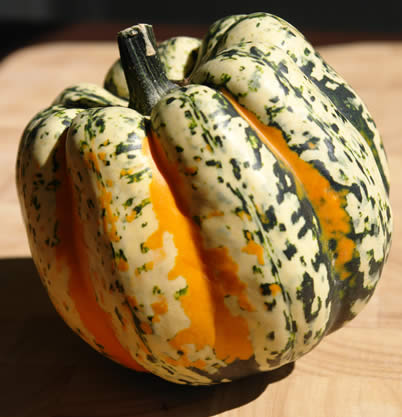
If there is one thing this gluten free blog writer loves this time of year, it is the seasonal squash. Pictured above is a beautiful Carnival (or perhaps some may call it a Sweet Dumpling) Squash specimen we just picked up here in Ohio, about an hour South of us, in Amish country (Holmes County to be exact).

I really love these particular squash, since in addition to being gluten free (as any squash), they have a rather mellow taste and are quite simple to prepare. Squash are generally a good source of fiber, beta carotene, potassium, and other nutrients too. So, it is a win-win for me!

To prepare one of these gluten free wonders, we simply wash it off well, cut the squash in half, dig out the seeds, place each half cut-side-down onto a plate with a bit of water on it, and then microwave it until the center pulp is sufficiently cooked (in our old microwave, this takes about 18 minutes). We serve these with just a bit of brown sugar. Oh are they just delicious!

The Carnival variety is especially nice due to it's more subtle flavor and rich buttery texture. It is definitely a less strong-tasting fruit than an Acorn Squash or Butternut (both of which are still quite wonderful), which makes it easier to convince children to give it a try. With gluten free diets, this is an important thing -- having nutritious options that people will eat.

Some other favorite varieties we look for this time of year include Turbin, Acorn, Butternut, and of course Pumpkin! Pumpkin is of course most popular served in pie filling - most excellent!

Throughout the year, we enjoy Spaghetti Squash too (another great gluten free alternative to real spaghetti!) - since you can dig out the stringy, spaghetti-like pulp and serve it with spaghetti sauce or pesto. Zucchini is also a nice one to just slice up into stir-fry along with yellow squash (great for colorful dishes), or to make into some wonderful casseroles.

Here's hoping that wherever you are, you have access to some of these wonderful gluten free food options!

Tuesday, September 19, 2006

First attempt at gluten-free multi-grain bread


Gluten-Free MultiGrain Bread

Gluten-Free Multigrain Bread Recipe Development

NOTE: Recipe Link to final, updated and improved bread at bottom of this article.

I have not focused much on recipes on this gluten free blog yet, but I intend to start addressing particular recipes as they come up.

Yesterday my wife made her first gluten free and wheat-free "multi-grain" bread, and I thought it was fairly good. It was a soda-bread type recipe that used Flax,
Quinoa flour, Sorghum, and Rice Flours for the main ingredients. It was simple to make and it was baked in a round 2-quart pyrex (oven safe) glass dish. It used some caraway seed (like rye bread uses for flavor) plus sesame seeds and a bit of honey on top.

Now that a day has passed, I can revise my original opinion of the bread. I found it to be just fine, and it was very good the first day. It has a bit too much flavor for a general sandwich bread, and did not hold up well enough for sandwiches anyhow. The texture was a bit more like a cornbread, which is fine for along with dinner and other foods, but not something I want to put peanut butter on. But, by day two, it was drying out and getting a bit crumbly. I do not know how much of this is attributable to the gluten free nature of the bread, since I have (in pre-GF days) had fresh Italian bread or similar get all dried out overnight too (especially when the air conditioner is on and humidity in house is low). Trust me: I am still eating the bread since I like the taste. But, I wish it would hold up better. We did not use any gums in this bread, but perhaps next time I will actually give it a try.

The bread did look rather nice at least! I took the above picture when it had just cooled after coming out of the over a couple hours prior. We will likely try making improvements to this gluten-free multi-grain bread recipe yet,... 


The Final Recipe emerged...

UPDATE: which we did, and the wonderful Gluten-Free & Wheat-Free Artisan-Style Multi-Grain Bread Recipe is now online at that link, along with a nicely-formatted PDF version of the Gluten-Free Artisan Bread recipe too.
This is what it turned out looking like:

The Wonderful Artisan-Style Multigrain Gluten-Free Bread
Continue to read this Gluten-Free Blog for all sorts of gluten-free recipes, product-reviews, and related information. In addition, visit my Gluten-Free Recipes Site where many of the recipes I have featured on this blog are available.

Thursday, September 14, 2006

Quinoa for a Gluten-Free Dinner or Side

One of the favorite dishes this gluten free blog author enjoys is Quinoa. For those of you who are new to Quinoa, it is gluten-free (of course, or I would not eat it), and it is considered an ancient grain that dates back to the Inca civilizations in South America. It is one of the best sources of vegetable protein around, and it has a fair amount of dietary fiber (5 grams protein, and 3 grams fiber per 1/4 cup uncooked grain). The grain has a delicious, somewhat nutty, light flavor that goes well with many other dishes.

We buy the Ancient Harvest brand of Quinoa, which also happens to be certified organic for anyone that cares. And, we just follow the basic cooking instructions on the side of the box, which is basically to cook 1 part quinoa with 2 parts water (or, add some chicken broth if you like). Cooks up in about 15 minutes or so.

I have found this grain to be quite versatile. Not only is it great on it's own, it is easily complemented by other vegetables and meats. It makes for a nice change of pace where you might otherwise use rice, like in a stuffed-pepper recipe. I enjoy frying up some fresh zucchini, some chopped bell peppers (red, orange, green), and some onions to go with it. And, add a little bit of San-J Gluten Free Tamari (GF Soy Sauce essentially), and you have a wonderfully simple and tasty main course or side dish.

Time to go whip up a batch to go along with tonight's dinner!

Monday, September 11, 2006

Celiac and Delayed Reaction Allergic Responses to Gluten

I was recently discussing (on a forum) how my personal experience with gluten intolerance involves a delayed allergic reaction once I am exposed to wheat or gluten containing foods. One helpful member (Al, at celiacforums.com) provided some great information about the two types of food allergies people commonly experience.

The following is information he provided:


Technically, Celiac Disease is considered a "delayed onset". However, some people know right away when they've been [exposed to] gluten. Everyone reacts differently.

When it comes to food allergies, there are typically two kinds:

* Type 1 (Classic, Immediate-Onset, IgE-Mediated): The reaction time occurs anywhere from seconds to up to 2 hours and typically affects the skin, airways or the digestive system. Conventional skin “scratch” tests are commonly used to detect this type of food allergy.

* Type 3 (Food Intolerance, Delayed-Onset, IgG-Mediated, IgA-Mediated):
The reaction time occurs anywhere from a couple of hours, and up to 2-3 days, after consumption of the food, and any system, tissue or organ in the body can be affected.


http://wheat.pw.usda.gov/ggpages/topics/celiac.html

Quote:
Celiac disease is thought to involve delayed immunoreaction and patients would not generally be expected to have an immediate and violent reaction to eating wheat whereas allergic reactions of the immediate hypersensitivity type might be both immediate and violent. It is also possible that both immediate hypersensitivity and delayed reactions might be present in the same person. There is a considerable potential then for confusion between allergy and celiac disease. It may be difficult to distinguish immediate hypersensitivity reactions or allergies from celiac disease as traditionally defined, but more research on this problem is needed.


http://www.enabling.org/ia/celiac/faq.html#symptoms

Quote:
Reactions to ingestion of gluten can be immediate, or delayed for weeks or even months.

The amazing thing about celiac disease is that no two individuals who have it seem to have the same set of symptoms or reactions. A person might have several of the symptoms listed above, a few of them, one, or none. There are even cases in which obesity turned out to be a symptom of celiac disease.


People do become more sensitive to gluten once it's been removed. Smaller amounts will set off reactions, than before (e.g., before going completely Gluten Free with your diet). Many have noticed this effect.


I found all this information to be very helpful, and I hope other do to. Thanks, Al, for providing such great links, quotes, and insight into the condition.

Friday, August 25, 2006

Enzyme that can break down Gluten proteins...

I originally posted the full story over on my other blog: Celiac Gluten-breakdown Enzyme news.

In short, the news was about how in a laboratory setting, scientists have developed an Enzyme that is effective at breaking down Gluten even in a highly acidic environment (read: your stomach perhaps).

They have work to do to perfect it and produce a pill (or food additive) for celiacs to process gluten as they eat, but they are working on it. Clinical-Trials are coming soon, which could be good news, though I can not say I want to volunteer for that :)

From what I understand and have heard, what makes this different from a few existing enzymes that can supposedly break down gluten and make it safe for celiacs, is that this one is actually effective in the stomach (yeah, that is a requirement to ever be effective). There are things like gluten-ease (something like that -- I have no experience with it) that people say may help lessen the impact of gluten-containing foods if you are accidentally exposed, but this news deals with an enzyme that will truly be effective at breaking gluten down completely. I'll be watching for updates to this story.

Tuesday, August 22, 2006

Gluten Free / Celiac baking with Buckwheat, Amaranth, and more...

I find myself perplexed by how so many Celiacs and gluten-free / wheat-free persons are not well informed when it comes to some of the gluten-free flour alternatives that are available for baking with. There are a host of grains to choose from that are gluten-free which seem to be "off the radar" for many, including authors of various GF Cookbooks.

All of the following grains are gluten-free, and should be so long as the source you are purchasing them from certifies that they are not cross-contaminated by processing on shared equipment (with grains that would contain gluten):
  • Sorghum
  • Teff
  • Buckwheat (it is a fruit technically)
  • Amaranth
  • Millet
  • Quinoa (said "keen-wa")
There are various sources that will supply these grains and certify each as completely gluten free. So, why is it that I read books like "Gluten Free Kitchen" where the author (Roben Ryberg) states that she avoids these due to the debate simmering over whether they are safe for Celiacs or not. It does not take much research to find a ton of information that spells out clearly why these grains, in their pure form, are free of gluten. The only potential issue I can see, as with any flours (including rice, corn, potato, bean, tapioca, etc), is whether they are processed in a facility that could accidentally cross-contaminate the product.

So, research your options and consider some of these alternative grains. In addition to variety in your diet, you may receive additional health benefits. Here is a link to an article about how Buckwheat May Be Beneficial For Managing Diabetes for example. Some of the other grains I mentioned are quite high in protein (like Quinoa) and high in fiber too (and, dietary fiber can be hard to obtain in sufficient quantities using starches and white-flours -- like potato, corn, rice -- that have been stripped of nearly all fiber).

Follow this link if you would like to read some rather technical information about celiac and gluten free grains according to the USDA. This should satisfy even the most analytical among readers -- especially interesting are the figures toward the bottom of the page that show the genetic relations between various grains and help make clear why certain grains are gluten-free and why others are not (based on family / subfamily of grains).

So, unless someone can offer definitive proof why these other grains are not safe (if pure and uncontaminated by other grains), I think there is plenty of evidence to back up a decision to use such flours in your gluten free and wheat free baking. I suggest that authors of gluten free recipe books do their homework before writing and telling people to avoid these grains also.

Monday, August 21, 2006

Testing for Celiac - Stool testing vs. Blood testing

I wondered how many persons out there have been tested for gluten sensitivity / Celiac Disease using EnteroLab's Stool Test for Celiac Disease. This non-invasive testing method claims to be more specific, and more sensitive than existing blood tests (and, per implication from what I can gather, endoscopic biopsy of the duodenum). Moreso, you can do the test at home, since you are just mailing in a sample you collect in the privacy of your own home.

I heard about this through a friend of a friend; someone that had Celiac and was suffering some terrible issues related to it, but the "standard" blood-tests and biopsy did not detect it. Yet, every time anything with gluten was consumed, substantial issues arose. Then, they tried this fecal/stool test which showed a positive result for Celiac disease and gluten allergy. But, this is all second hand and I have no hands on experience.

If you wonder what price accompanies each test (I say "each", since they offer a series of tests including gluten sensitivity, milk protein - casein - sensitivity, soy, colitis, intestinal malabsorption, and a few others) . This is a link to the Enterolab Tests from which you can reach the pricing information for each test (and/or "panels" of tests). The basic gluten test seems to be $99.00 if I understand right. They have gene testing / genetics testing as well that looks for genetic markers that would predispose you to celiac or gluten-sensitivity too (that one appears to be $149.00). They claim your insurance may pay for the tests (I'd surely check with my insurance before ordering though - I would not just assume).

I'd love to know how effective they are and whether to recommend to others. I presume you would have to consume gluten prior to the test for a positive result, but it may be worth taking a bit of something otherwise prohibited and ordering the test just to find out. Celiac Sprue detection to-date seems a bit hit or miss, and I wonder if this test is really better.

If anyone has experience (first hand) with these tests, please share any info that may help others.

Saturday, August 12, 2006

Celiac Disease and Down Syndrome

Ok, so I was reading this latest supposed scientific "news" item (2006-08-11) about how Celiac tests in Down children may fail, and quite honestly, I just do not understand what is newsworthy at all in this article.

It talks about how ". . . early treatment does not appear to improve the child's quality of life or improve outcomes from one of the long-term consequences of celiac disease . . .", with regards to Down Syndrome patients with gluten intolerance issues (i.e., Celiac); but it never mentions a thing about what those "early treatment" items are. To my knowledge, there is no early treatment aside from absolute avoidance of gluten in one's diet. And, the article talks about how there are tests to detect whether a Down child has Celiac (or is prone to) before developing symptoms -- ok, how is that any different than the tests for any person??

I regularly scour the internet for scientific news that may be helpful to the gluten-free / wheat-free / celiac community, and when it came to this bit of "news", I just found myself asking: "and, how is this news?" Perhaps I am wrong, but I have to believe someone just happened to get some grant money to study a relationship between Celiac and Down Syndrome, and then publish "findings" that really are nothing more than common and well accepted knowledge about Celiac and gluten-free living that applies to all of the population, and not just Downs.

If somebody can clarify this, feel free to post here and help me understand. I can understand that Down patients may be more likely to have a genetic predisposition to Celiac, but that still would not change the point of my comments above.

Tuesday, August 08, 2006

Celiac Disease - A Hidden Epidemic - book review

My mother just finished reading the book "Celiac Disease - A Hidden Epidemic - Unmasking One of the Most Underdiagnosed Autoimmune Diseases" by Peter H. R. Green, M.D., who is the Director of the Celiac Disease Center at Columbia University. Though I have personally not had the opportunity to yet read it, she highly recommended the 280 page book.

From what my mother describes, it sounds like the book goes into a fair amout of detail about everything from ingredients that are safe or not, as well as what foods/products in the USA to look out for any why. She summarized some of the following (not sure what is or is not a direct quote) from the book:
  • SAFE GRAINS: Rice, Corn, Millet, Teff, Sorghum, Wild Rice, Buckwheat, Quinoa, and Amaranth. (oddly, I did not notice Tapioca, bean flours, pea starch, and other obvious ones in the list -- perhaps my mother just omitted from her synopsis).
  • AVOID: Rye, Barley (barley malt), bulgur, couscous, spelt, kamut, semolina, triticale, and einkorn.
  • OATS: The protein in oats was shown to cause a reaction in a few celiac patients similar to that of the gluten peptides. But most people with celiac tolerate oats well and they are regarded as safe for most celiacs. Patients ingesting oats sometimes have more symptoms due to the increase of dietary fiber, but very few have any type of immune reaction. Oats add both fiber and variety to the gluten-free-diet -- elements that are frequently lacking. The issue of cross contamination of grains during growth or manufacturing process was discussed. You are urged to buy oats from mills that are either dedicated to gluten-free products or recommended by knowledgeable sources.
  • YEAST: Baker's yeast, autolyzed yeast, and autolyzed yeast extract are gluten free. Brewer's yeast if not gluten-free unless it is found in a dietary food supplement, in which case it is gluten-free. All distilled vinegar is gluten-free. Malt vinegar is not distilled and is the only one to be avoided.
  • MALT: Malt extract, malt flavoring, malt syrup, and malt flour are all made from barley and should not be used.
  • Maltodextrin in the US, is made from corn, rice, or potato and is safe. Wheat is sometimes used in Maltodextrin in imported products and it should be labled as "maltodextrin (wheat)" or "wheat Maltodextrin".
  • STARCH: In foods, "starch" is always cornstarch and is safe. Modified food starch is almost always cornstarch, it could be wheat starch (my comment: I have read that modified food starch in products made in the USA is always cornstarch, and this is what I find most annoying with the whole GF thing -- finding CONSISTENT information).
  • Pharmaceuticals: both starch and modified food starch could be wheat starch.
  • Many soy sauces are fermented from wheat and, if so, should list wheat on the label. When soy sauce is an ingredient within another food, the source may not always be declared - use at your own risk.
  • Pure spices are gluten free. Gluten-containing grains are rarely used in a flavoring, except in meat products and products that contain meat.
  • Carmel color is safe--corn is used. Though the FDA permits Malt syrup, corn is used as it makes a better product. (my thoughts... sounds lovely and all, but what about the manufacturer that gets a deal on barley and says "so what if corn makes a better product - barley is cheaper, especially now that people are using corn-ethanol in their gas tanks!".)
  • Barley malt, not gluten free, is sometimes used as a flavoring, it should be labeled. In rare instances, barley malt is used as a flavoring but not identified on the label.
  • Citric Acid made in the US is made from corn. European producers might use wheat.
  • Dextrin (FDA allows wheat) but they say corn is used in the US. Imported Dextrin could be wheat.
There were other notes mom mentioned about the book to interest me in reading it. Next time I see her I will try to get hold of the thing and give it a proper (first-hand) review. The book is Published by Harper Collins, 10 East 53rd Street, NY, NY 10022 Copyright 2006 -- perhaps that will be enough info for you to easily locate a copy if interested.

Wednesday, August 02, 2006

Prevalence of Celiac Disease

Every day it seems I read yet another article telling of how the prevalence, or certainly the awareness of the prevalence, of Celiac disease is on the rise here in the United States. Other countries like Italy have long recognized this issue as a widespread problem affecting their population. But, the USA has lagged in awareness for a variety of reasons, primarily due to ignorance on the part of the general Physician community. Too many doctors have been educated in a system that told of Gluten Intolerance (Celiac Disease) as a disease that affects one in 5000 (quite rare), and as such they are not looking for it being the root cause of symptoms their patients exhibit.

But, this is (perhaps, and hopefully) changing. I hope that doctors in general are reading some of the same publications I do, and getting in touch with how widespread this disorder really is. This recent article about how widespread Celiac Disease is provides yet another example of the type of information I am talking about. And, some interesting quick-facts from the article include these quotes:
  • Researchers now have data showing that celiac actually affects one person out of 100. That makes it the most common inherited autoimmune disease in the United States.
  • Millions of adults have celiac and don't even know it.
  • Bones can become brittle, blood has a harder time carrying oxygen, and brain function may be compromised. Nerves that detect pain may go haywire, resulting in tingling, burning or numbness in the hands or feet and legs.
  • ...often called the "Great Imposter" because it frequently mimics chronic fatigue, osteoporosis, irritable bowel syndrome (IBS), dermatitis or dementia.
  • (Read the article to get more detail)
I was one of those who fit the bill for the situation described in the opening paragraph of that article: "...imagine that your doctor keeps telling you that there's nothing really wrong with you and that it's all in your head...". Yep, doctors just kept telling me there was nothing wrong, as I kept deteriorating further and further.

Luckily, I had a hunch it was what I was eating that was causing my issues, so I started keeping a detailed log-book of everything I ate. I was not even aware of what Celiac disease was at the time, having absolutely no exposure to information on it. Only after my log book kept correlating my apparent "hives", various pain, and problems with my equilibrium (loss of balance) closely with consumption of Wheat-Containing products, did I start to get a clue. And, it was rough, since EVERYTHING (basically) has Wheat and/or Gluten in it it seems. After reducing my diet to just fresh fruits and vegetables for a couple weeks, and slowly introducing other foods back in to my diet, did I catch on to the trend.

The thing that threw me off course in my own "self diagnosis" was that once I thought for sure the common-thread causing problems was wheat, I'd have symptoms after eating something that did not contain wheat. Only later after learning about what Celiac disease was did I learn of that the component in wheat that was likely causing the issue was gluten (a protein), which appears in a variety of other grains -- some of them being favorites of mine like Barley, Rye, and even Oats to some extent (there's a bit of debate there, mostly due to cross-contamination issues). But, after learning about Celiac and Gluten Intolerance, amazingly those foods that were still triggering hives and such happened to contain gluten sources in them.

With this information in hand, I met with my doctors, and they still overwhelmingly felt (feel?) that it is in my head, though my hives are now gone, and other symptoms are gone as well. The only doctor that listened to me and really took the Celiac thing seriously was my Allergist, who had experience with others afflicted as such. Thank God -- someone that finally listened and was educated on this disease. It has been a few years now, and since leading as close to Gluten-Free as possible, my life has made a dramatic turn for the better. All because I became aware of the prevalence of Celiac Disease, and pushed to find a professional that was as well (I also tried to get my general-practitioners to get a clue, but I still am unsure if they "get it").