Wednesday, April 27, 2011

Gluten-Free Recipe: Quinoa and Smoked Gouda stuffed Poblano Peppers


Here is another recipe for our free Gluten-Free Recipes collection — this time it is a vegetarian adaptation of a recent recipe that was inspired by a very tasty dish I first discovered at a local Mexican restaurant here in Texas. I first posted the non-vegetarian gluten-free original Stuffed Poblano Peppers with Chicken and Smoked Gouda recipe (link) a couple weeks ago, and now I have added this vegetarian and gluten-free version: GF and vegetarian Recipe: Quinoa and Smoked-Gouda stuffed Poblano Peppers (link)

This vegetarian version retains its healthier (than the restaurant version) approach to the recipe with much less sodium and considerably less fat, while retaining a delicious combination of flavors and textures.  The quinoa grain is not only a great gluten-free diet addition, but also a much tastier and fulfilling "stuffing" than plain rice would be.  Combine this seasoned quinoa with the large mild green chiles (Poblanos) used for this recipe — which are most excellent for stuffing thanks to their relatively thick walls  — and you have a feast for the senses.

These poblanos are not particularly "hot" peppers (when green like this), though you may find they have a subtle slightly-detectable warmth that can vary with each individual pepper. The flavor is a bit different than a sweet green pepper, though the poblano will not be too much of a taste surprise if you enjoy peppers in general. To infuse a bit of extra Mexican inspired flavor into our dish, we have used some ground chipotle powder (chipotle peppers are simply a smoke-dried jalapeño); the subtle smokiness from the smoked Gouda furthers that theme a bit.

As with the chicken-containing version from before, I have not added ANY salt to this dish aside from what is in the cheese, all in an effort to keep this dish low-sodium and generally "healthy" and safe not just for wheat-free and gluten-free diets but also for low-sodium and lower-calorie diet considerations also.  Vegetarians and meat-eaters alike can enjoy this dish, as it is delivers a great and satisfying combination of taste and texture.  Add a bit of diced avocado (as shown) for a nice complementary flavor too. And, if you do like a bit more heat, you may enjoy adding some minced jalepenos or habaneros to the mix.

Tuesday, April 19, 2011

Ban "stock photos" from cookbooks, food magazines, etc.

This Gluten-Free Blog discussion will apply to more than just the gluten-free community today.  I have chosen a topic I feel is important to all us "foodies" and consumers in general: the widespread use of "stock photography" and how these photos are increasingly being displayed alongside recipe and food products in place of photos of the actual product or recipe-output.

Are you of the opinion that the use of "stock photos" in cookbooks, food magazines, menus, food blogs, food advertisements, and the like is tantamount to fraud when there exists, either subtly or strongly, the implication that the food-photos you are viewing are pictures of the actual food(s) you can create using an accompanying recipe, or are pictures that show a reasonable representation of the actual prepared food(s) that you will receive if you purchase the pictured product?

Well, I for one believe the widespread practice of using undisclosed "stock photos" should be banned for a variety of reasons, and I am not alone according to a recent article on NPR's website.  Consumers are getting annoyed by this misleading practice.

The NPR article discusses the case of a Vegan (foods) website and magazine caught using stock photography of non-vegan foods to accompany vegan recipes: with their being a clear implication that the pictures they used were demonstrating their vegan recipes in action.   CONTENT WARNING: NPR's site links to a blog (Quarrygirl) that "busted" the VegNews site/magazine, and that blog contains language not suitable for children.

Perhaps I should back up a bit and start by asking: are you familiar with the term "stock photos" and how such photos are used?  Put simply: stock photos are pictures of nearly anything and any subject matter that are for sale to anyone that wants them — especially pictures of things that looks really good and look like a professional performed the layout and photo shoot.  Sounds great, doesn't it?  Just buy a wonderful looking photo to fill your needs!  Sure saves time and effort of taking a great looking photo yourself.

But wait... what if you are telling everyone about this great new recipe you created and are unable (or unwilling) to take the time to snap a picture of your item; instead, you simply buy a picture of what you feel is an ideal representation of your food and then display that picture with your recipe and imply that what is pictured was the end result of you following that recipe to completion?  Well, to me, this is where a serious line has been crossed!


The practice of using "stock photos" has sadly become a "generally accepted" way many in the industry choose to save money, all the while diluting and diminishing the credibility of recipes and related work by those of us that really make the effort to acquire actual pictures of what it is our recipes produce.  I refuse to accept this practice as necessary in an age where digital photography has made the acquisition of high-quality images simpler and cheaper than ever before, nor will I accept this practice as ethically correct as I feel undisclosed use of stock-photography is a form of deception.  
For these reasons, the photos of all the desserts in our Wheat-Free and Gluten-Free Gourmet Desserts Recipes book are photos I took of the finished products that we baked ourselves and according to the recipes in the book.  And, the photos of recipes on this Gluten-Free Blog and on our Gluten-Free Recipes Library are also pictures of foods we baked, according to our gluten-free recipes.  The pictures across the header of this page: yes, they too are gluten-free foods we baked and took pictures of.
It really annoys me how prolific the use of "fake" pictures is these days (i.e., stock photos posing as a custom recipe's output or a product other than what is truly in the photo).  Why?   People have gotten to where they assume that everything they see is misleading, especially in our culture that seems more focused on what is "legal" versus what is "right".  Using stock photos is legal, though I believe a disclaimer should accompany such use if it is implied that the photo represents a product your are buying or the end-result of a recipe you are buying.  We are all used to television ads with that barely-readable print at the bottom disclaiming that all images shown were simulated, sequences were altered, etc.  I believe similar disclosure (though more legible) should appear with stock photos used as discussed herein.

Perhaps another question should be asked, especially of magazines and the like selling recipes and using stock-photos to represent the outcome of baking their recipes: if you are using stock photos, how do we (the readers) know you ever even baked the recipe in order to assess its merits (accuracy, taste, texture) and know it is worth presenting as something we will likely enjoy?  Or, are we to assume that while custom photography is "too expensive", somehow baking each and every recipe and assessing its merits is somehow affordable by comparison?  From my own experience, taking all the custom photos is time consuming, but no more so than creating and baking all our recipes. So, for this reason alone, I have substantial doubts that any place passing off stock photos to represent their recipe outcomes is really taking time to bake all their recipes either.  

Feel free to share your thoughts on whether you think stock-photos are misleading!

Thursday, April 14, 2011

Gluten-Free Recipe: Poblano Pepper stuffed with Chicken and Smoked Gouda

Poblano Pepper stuffed with Chicken and Smoked Gouda
I just added another recipe to our free Gluten-Free Recipes Library — this time it is a recipe that was inspired by a very tasty dish I first discovered at a local Mexican restaurant here in Texas that I really enjoy.  My version is a bit healthier than the one I get at the restaurant (much less sodium and considerably less fat), but it still retains the essence of the dish that I so enjoy, and now I can make it at home whenever I get a craving for a gluten-free meal featuring a Stuffed Poblano Peppers with Chicken and Smoked Gouda filling recipe (link).

Go to that link for the full recipe.

These gluten-free stuffed peppers are rather easy to make, and as a bonus, a "leftover" from the chicken preparation forms the basis for a simple-to-make gluten-free chicken soup! You will have two meals ready in the time to make one.

The large mild green chiles (Poblanos) used for this recipe are wonderful for stuffing thanks to their relatively thick walls. These are not hot peppers (when green like this), though you may find they have a subtle slightly-detectable warmth that can vary with each individual pepper. The flavor is a bit different than a sweet green pepper, though the poblano will not be too much of a taste surprise if you enjoy peppers in general. Here in Texas, these beautiful large poblanos have been very reasonably priced and abundantly available in the grocery stores, making this dish even more enticing.

We have infused a bit of extra Mexican inspired flavor into our dish with the introduction of some ground chipotle powder (chipotle peppers are simply a smoke-dried jalapeño) and some subtle smokiness thanks to some smoked Gouda (though, you could use any cheese you prefer). The core component of the filling is shredded chicken-breast meat from chicken that has been boiled with nothing more than water, some ground spices, and a sliced onion (hence, the leftover chicken broth for a soup!)

This gluten-free recipe results in a feast for the senses, though not in a tongue-burning way... this is much more subtle with regards to spice and heat.  I have not added ANY salt to this dish aside from what is in the cheese, all in an effort to keep this dish low-sodium and generally "healthy" and safe not just for wheat-free and gluten-free diets but also for low-sodium and lower-calorie diet considerations also.  I hope you enjoy this one as much as I do!

Continue to read this Gluten-Free Blog for all sorts of gluten-free recipes, product-reviews, and related information. In addition, visit my Gluten-Free Recipes Site where many of the recipes I have featured on this blog are available.

Wednesday, March 30, 2011

Gluten-Free Lemon-Bar Pie Recipe

This gluten-free lemon-bar-pie recipe emerged when tinkering around with another recipe I really enjoy — the "Lemon Bars" recipe from our Gluten-Free Desserts Cookbook provided the sweet yet tangy lemon custard filling (the recipe is on page 152 in the printed version; on the Kindle version, just use the search feature to locate "lemon bars" quickly).  The custard filling was combined with a simple to make pie crust yielding this "Lemon Bar Pie" (as I call it at home), or perhaps just "Tangy Lemon Custard Pie" for anyone not familiar with the reference to the gluten-free lemon bars this descended from.

When I get a craving for a truly lemony dessert, I want to feed that craving with enough lemon to do the trick: this calls for an abundance of tangy citrus goodness from fresh-squeezed lemon juice and the zest of those lemons.  So often, lemon-flavored products just do not feature enough lemon to do the trick; that is certainly not the case with this recipe... we embrace lemons and their awesome flavor.


The Pie Crust
The gluten-free pie-crust recipe for this creation was something my wife just tossed together as an experiment quickly, and if the notes I jotted down accurately reflect everything that went into the final product, it was:

  • ½ Stick Butter (i.e., 4 Tablespoons) - soft/partially-melted
  • ¼ Cup Sugar
  • ½ Cup Ground Flaxseed
  • 1 Cup Almond Meal
  • 1/3 Cup Unsweetened medium-shredded Coconut

This was mixed together in a bowl by hand until ingredients were equally dispersed for the most part.  Then, this was pressed into a pie pan (or, technically in this case it was a Pyrex pie plate).  The crust was baked for approximately 25 minutes at 325F before adding the custard filling and baking it another 25 minutes or so (until the lemon filling sets up).


The Lemon Custard Filling
The gluten-free lemon bars custard-filling recipe (from our cookbook) is rather simple and very much lemon-centric, using just the following ingredients: a few lemons (their juice and zest), a few eggs, some sugar, and a bit of cornstarch.  There is no watering down that lemon power... lemons provide all the liquid here.  That's it... a potent lemon filling for our pie.  Exact custard recipe can be found in either of these:


The Result: Gluten-Free Lemon Lover's Dessert


I certainly enjoyed the outcome of this combination of wheat-free / gluten-free crust and filling.  The coconut and almond in the crust provided wonderful synergistic flavors that blended beautifully with the tangy-sweet lemon custard.  In addition, the ground flax, almond meal, and coconut provide a more hearty texture to the pie crust.

The pie version maintains its dedication to the all important lemon flavor while slightly de-emphasizing the lemon — as compared to the original lemon-bars which have a very neutral base/crust where the only added flavor is perhaps a bit of vanilla —  this crust contributes more flavors of coconut, flax, and almond that combine with the lemon wonderfully.  

If you are a lemon-lover like me, I am sure you will enjoy both the original gluten-free lemon-bars and this lemon-bar-pie variation!  Yum!

Monday, March 07, 2011

Gluten-Free Pizza Crust Recipes

Gluten-Free Pizza Crust Recipes

Thick Crust, Thin Crust, Batter Crust... you choose

This blog posting was inspired by a friend contacting me the other day looking for a gluten-free pizza-crust recipe he could bake that would satisfy his craving for a good pizza (he has just recently joined the ranks of the Celiac / GF population).  He had just tried some store-bought pre-made GF pizza crust and was quite disappointed with it, so I pointed him in the direction of our gluten-free recipes library after quickly mentioning what types of crust recipes we had made available online.  And, I figured I might as well recap the discussion here too for anyone else wanting a better gluten-free pizza crust than they can find at the store.

There are a few gluten-free pizza-crust recipes and approaches that we use regularly.  Each is quite different from the other, and offers substantial variation in taste, texture, and complexity (for creation).  Depending on how much time you have to prepare your pizza and/or what ingredients you have available and what type of crust style you prefer, one of these recipes should do the trick or serve as a great starting point for your own GF pizza creation.

Note: the section-headings below link to the recipes when clicked.

Gluten-Free Thick-Crust Pizza Dough Recipe

Gluten-Free Pizza Crust Recipe : Thick Crust

This is my own personal favorite — a lovely Thick-Crust Pizza that is very much like the "real thing"; and, though it takes a bit of investment with regards to preparation time, the satisfaction of eating a near-real pizza makes up for that.   This is a wonderful traditional raised pizza crust with thick bread-like outer crust edges that is both dairy-free and gluten-free, with great taste and texture.

We make use of Millet and Teff flours as well as yeast (combined, these all help result in a very convincingly "real pizza crust" flavor).  This is a yeast-raised dough, and as such it takes a bit of time to make (crust needs time to raise... about 40minutes just for that), but it is worth it if you really miss "real" pizza.  And, though I typically avoid Xanthan Gum and all gums in my foods, I make a rare exception when it comes to this Pizza crust my wife developed.

Load the crust down with your favorite pizza sauce and toppings and enjoy!  I know I do.
Gluten-Free Pizza Crust Recipe : Thin-Crust Variety

This Gluten-Free Thin-Crust Pizza Dough recipe produces a very convincing pizza crust that will have a crispier, crunchier outer crust edge once baked, and an overall texture and taste quite similar to the real thing. This is more of a thin-crust type pizza, and we have found this recipe to be great for sheet-type pizzas.

Though this recipe contains yeast, it is really a baking-powder leavened recipe (the yeast is for flavor) so there is no waiting for the dough to rise prior to baking. The crust is pre-baked (before placing sauce/toppings on it), and then baked a bit more to melt the cheese(s) and cook any toppings.

And, though I posted this picture of the thin-crust pizza on my blog in the past, I just noticed that I have yet to post the picture(s) onto our recipe library. oops!  I will update that soon, but at least the recipe is there for all to see. :)

Batter-type Thin/Medium Gluten-Free Pizza Crust (simple/quick Recipe)


The batter-type approach to a pizza-crust makes for a decent pizza in a bit less time than some other alternatives, as it is made quite similarly to a pancake.  It is also baking-powder leavened so there is no wait for dough to rise.  The batter is poured into pan(s) on the stovetop where it is fried before applying toppings.  Once toppings are added, the pizza(s) are finished by baking in the oven.


PIZZA SAUCE NOTE:
Sauce:  there is a  homemade gluten-free pizza sauce recipe on our website in case you need or want one. It's really simple to make, and has a good flavor on pizzas.  


ENJOY!
The techniques used in these various crust approaches should give you a nice foundation for creating your own variations too.  I have made all sorts of related recipes and have even created adaptations using things like Whey Protein and pre-hydrated Chia Seed slurries and more (in lieu of Xanthan Gum).  Experiment with various flours and create your perfect taste and texture; perhaps you like Buckwheat or flax seed more than other flavors... the sky is the limit.

All this talk of pizza has me craving one now! mmmmmm... pizza!

Continue to read this Gluten-Free Blog for all sorts of gluten-free recipes, product-reviews, and related information. In addition, visit my Gluten-Free Recipes Site where many of the recipes I have featured on this blog are available.

Monday, February 21, 2011

Eggs, Salsa, Pesto, and Spinach : Oven-Baked in Cast Iron Pan


We really like baking our gluten-free recipes in US Made cast-iron pans whenever possible, and this Lodge (brand) Cast Iron "Cornbread Skillet" (their model 8CB) makes for a lovely oven egg-roasting device.  I prefer cast iron for my gluten-free kitchen for many reasons (as enumerated in that gluten-free blog-link entry), and we are always looking for creative ways to put the pans to use.

This time the gluten-free recipe to be baked in our cast-iron was: eggs with habanero salsa, jalepeno/cilantro pesto, and baby spinach.  And, it does not get any easier than this... just crack those eggs open and place a couple in each of the triangular "slices" areas in this nifty little pan (after applying some cooking spray to the pan), then push some leaves of baby spinach down into each section and top with some pesto and/or salsa (I really like the hot habanero peppers accent for a "Southwest" fried egg of sorts).  Then, bake at 350F or so until the whites of the eggs are fully cooked and the yolks are the way you like them (these were baked until the yolks were just slightly runny in the middle, and they were fantastic).

We went to using this cast-iron "cornbread skillet" for this GF recipe since, after trying supposed "non-stick" muffin pans, we found ourselves dealing with anything but a non-stick post-baking cleanup.  By contrast, this pre-seasoned cast-iron Lodge skillet/pan cleaned up super easily.  I do not know what ever possessed me to even TRY a "non-stick" pan instead.  Fact is, if I could get every single baking pan/sheet made in cast-iron, I would... the stuff is fantastic and lasts forever.  Sure, it is *heavy*, but that just provides a bit of exercise while baking :)

Monday, January 24, 2011

Gluten-Free Crab Cake Review: Handy GF Crab Cakes

After thinking about it, I realized I had not enjoyed a crab cake since I first went gluten-free quite a few years ago.  In previous times, I enjoyed good crab cakes at restaurants (never made them myself), and once I had to give up gluten in my diet, I gave up crabcakes too since I figured I would not find a satisfactory gluten-free option ever again.   Thankfully, times have changed, and I am pleased to have found an excellent option: Handy (brand) Gluten-Free Crab Cakes.  


You have probably seen the Handy brand before (they are well known and in many stores), but the certified gluten-free variety of their crab cakes is a new addition to their product line, and a very delicious one at that!  These new gluten-free crabcakes were brought to market by Handy International in December 2010 as what they claim to be the first gluten-free and certified-GF (GFCO; i.e., less than 10ppm gluten) crabcake on the market.  I welcome the gluten-free product, and its certified status is certainly a nice product feature that I wish more companies would get on board with for Celiac-friendly options.
 

The Product: Packaging and Ingredients
These lovely gluten-free crabcakes come in a 6-pack format with each individual crab cake being a 3-ounce cake (for 18 ounces total).  So, you get over a pound of high-quality crabcakes per package.  And, upon further examination, those 6 crabcakes are packaged within the box as 3 sleeves of 2 crab cakes, which I thought was a wonderful detail -- you can take out a package of 2 frozen crabcakes without breaking the seal to the remaining ones.  This is very "handy" indeed!  :)


The formula for their gluten-free crab cakes recipe looks pretty much like what you'd expect if you were making your own crabcakes.  The formula is quite simple and what appears to be quality ingredients.  And, just by looking at the cakes, you can immediately discern nice chunks of crab meat - which is the most important part of course (and, crab meat shows as the first ingredient; a good sign!)  I have heard that, since posting this ingredient-list on their website, that the product has been made dairy-free too... but, you may want to check into that on the actual package you purchase.

Preparation & Cooking (Frying or Baking)
The first thing I must say is that baking these things could not be much simpler: just thaw the gluten-free crabcakes you plan to bake, then follow the instructions on the box for frying, baking, or whatever.   We placed ours into a cast-iron pan and baked them in the oven (the whole process takes less than 1/2 hour).  Here is a picture of them shortly after we got underway with the baking process...


The end result was quite nice, though we made ours on a cloudy day and with artificial lighting I was unable to get a picture that I really liked, so.... here is a picture that Handy had on their website, and I do think it accurately represents the results you can achieve baking or frying your own.  This IS what they look like, and they have a lovely texture with lots of crab meat throughout:
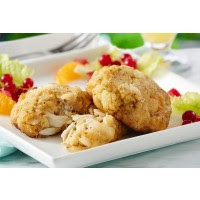
Handy (brand) gluten--free crabcake


Taste, Texture, and Satisfaction Evaluation
WOW! These really are quite wonderful!

Those chunks of sweet white crab are delicious, and the remaining ingredients in the crabcake are just enough to beautifully complement the crab meat.  If I had these crab cakes at a restaurant, I would be quite pleased - they are top notch and reminded me of some crab cakes I had years ago.  I have tried both baking and frying these crab cakes.  Each method works just fine and delivers a pleasing result.  I was able to get a delightfully crispy surface by frying them, but that of course introduces extra calories from the oil used in the pay.

I enjoyed the subtle seasonings they used, and my *only* complaint is that I find them slightly salty by the time I have finished an entire crab cake (we rarely add salt to anything, so commercial / restaurant foods are generally salty to me).

My wife and I found the 3-ounce portion to be ideal.  I think these would make a great appetizer item for both home and restaurant settings.  I can see them coming in quite handy (nice brand name it turns out) for parties and gatherings where you want to serve something rather impressive without the fuss of making it from scratch.  These crab cakes are almost certain to be a hit with anyone that enjoys crab - I have to believe that caterers with Celiac or gluten-free clients in mind will find these to be a great service option.

Where to Purchase + Price / Cost Discussion
Please, read this section entirely if you are interested in these.  The Handy gluten-free crab cake price varies CONSIDERABLY based on where you obtain them - they range from moderately priced to extremely and ridiculously expensive depending where you get them.

The EXPENSIVE way to get these...
Handy Gluten-Free Crab Cakes are available online at the company's dedicated  Gluten-Free Crab cake website, but I suggest you check your local store first. The reason I say to check your local grocery store(s) first is quite simply that the price at Handy's online-orders website is may be a bit out of range of the average consumer, especially after you add FedEx shipping (which requires dry-ice packing no doubt), but still, OH MY! Handy seems aware of how prohibitive this pricing is, and they too encourage you to shop locally for the product if possible (they have a web page listing stores where available - click the "buy locally" tab at the top of their site for list).

If you have no other option, perhaps... and, here are the online options Handy offers:
  • $25.99 for a package of 6 crabcakes : (i.e., a cost of $4.33 each); add shipping yet!
  • $47.99 for a package of 12 crab cakes : at a price of $4.17/each, without shipping added yet!

The more reasonably AFFORDABLE way to get these...
See if your local grocery store has them!  In the Houston, TX area, I quickly checked at the local H.E.B. store and found these Handy Gluten-Free crab cakes, but only in a *2-pack*.  HEB offered the box of 2 gluten-free crab cakes for $7.99 - or, essentially $4.00/crabcake, which to me sounded reasonable compared to the cost of a crab cake at a restaurant or such.  And, because they are high quality cakes full of tasty crab meat, this did not sound too out of line with the price of just purchasing crab meat on its own.

But, here is my problem with the Gluten-Free (version) pricing: why are these crab cakes so much more than Handy's own "normal" (non-gluten-free) version of the same crabcakes? Each contains the same crab meat (the most expensive part), coupled with a bit of other binder-ingredients and seasonings.  So, why can CostCo offer the 6-pack of *regular* (i.e., with-gluten) Handy Crabcakes for only $13.89 (i.e., $2.48 per crab cake?)  Volume?

If I could buy the Handy gluten-free crabcakes at CostCo for the same price of the "regular" (gluten-containing version), it'd be a "no-brainer" for me, and I'd have them much more often.  But, the cheapest option I have seen for the gluten-free version is a full 60% more.  That seems like a substantial premium for just swapping out some breadcrumbs with a gluten-free variety.  Though, I guess there is the cost of certification (GF) and the lesser volume production, right?  Handy's web site shows Costco carrying the gluten-free varieties, but ONLY in Hawaii and some California locations (hopefully that changes to include more locations).  I will purchase these, for now, at our local HEB store on occasion, as the $4/crab-cake price is not TOO bad, and they are quite tasty.

Conclusion
If you are lucky enough to live near a local store that carries the Handy Gluten-Free crabcakes, they are most definitely worth trying if you enjoy crab meat. This product has given me back a once-favored restaurant menu item, now in the form of a crab cake that is safe for my gluten-free diet, and in a form I can prepare quickly and enjoy whenever I want.

I wish the product was made in the USA, but I am not going to over-analyze the offshore production of this product (they are made in Thailand).  The fact is, I regularly use super-fine Asian flours (tapioca, white rice and sweet rice especially) sourced from Thailand in my Gluten-Free Desserts baking - I get those at local Asian markets. Seafood is a different  thing altogether perhaps (since water quality issues come into play), but if that is where the fresh Blue Crab meat (used in these crabcakes) is available in sufficient quantities for producing these items, so be it.  When I queried Handy International's contact about the overseas-sourcing and any concerns with the quality, this is what they respond with:
"We subject ourselves to independent testing by Silliker, a top inspection firm used by Whole foods and Costco. Handy’s plants have received Silliker’s gold certificate – an achievement only the top 10% of inspected companies achieve. Handy is also a founding member of the National Fisheries Institute’s Crab Council, a groundbreaking group focused on creating a more sustainable seafood offering, and works diligently to provide the most consistent high quality products the crab community has to offer.”

I am personally OK with this representation of quality testing, and I will continue to consume their product.

Bottom line: a great new option for my gluten-free diet!  Delicious crab cakes anytime I want them :)


Continue to read this Gluten-Free Blog for all sorts of gluten-free recipes, product-reviews, and related information. In addition, visit my Gluten-Free Recipes Site where many of the recipes I have featured on this blog are available.

Monday, January 10, 2011

Gluten-Free Chocolate Cheesecake for the New Year

One of my favorite simple recipes to start the New Year out with is a Gluten-Free Chocolate Cheesecake.  I love cheesecakes, and it always amazes me how most all commercial cheesecakes manage to include some type of wheat and gluten in them, even though from my experience I can create any cheesecake I want without gluten.  The only "flour" in this cheesecake is cocoa. It is too bad I can not simply go to the store, or a restaurant, and order a slice of cheesecake that is safe for Celiacs.  So, in the meantime I bake one of these cakes at least once per year to treat myself (and others) to a fantastic GF cheesecake - my gluten-free diet must contain cheesecake on occasion: that is non-negotiable.

This cake recipe is straight out of our Gluten-Free Desserts cookbook (page 30), and it yields a nice thick and rich and creamy dessert that can also be kept frozen if you want to save part of it for a later date (which I did, after I at nearly half of this beast myself over a week's time). This cake will serve a nice sized party, since it weighs nearly 5# (it fills a 10-inch round springform pan to the brim); 3.5 pounds of that weight is from the cheeses in this delicious treat!  I just cut the chilled cake into pieces, wrap those pieces in plastic wrap, place those into freezer baggies, and freeze them until I want to thaw and eat more (after my recent mass consumption spree, it may be June until I get a piece out again. lol)

The cake makes a perfect recipe even for inexperienced bakers, presuming you have a decent mixer that can handle the pile of cheeses and other ingredients (our Kitchenaid works just fine).  I create the crust and get that pre-baked while mixing the cheesecake filling.  Total prep-time is no more than 1/2hr, and then another 70minutes of baking time.   Cool the cake overnight, and it is ready for eating by you and/or anyone else you would like to share it with.

Couple this cake with your New Years exercise plan, and it will work out even better :)

Thursday, December 30, 2010

Gluten-Free Carolans Irish Cream Liqueur : Excellent!

Carolans Irish Cream : Gluten-Free
(picture source : their corporate website)
If you have Celiac Disease and enjoy Irish Cream liqueurs, you may want to give Carolans Irish Cream Liqueur a try.  Their website clearly states on their FAQ page [note: last checked in 2016-SEPT, and still clearly gluten-free! The following quote is from 2010, where now it simply states that the product is gluten-free]:
"Carolans is suitable for Celiacs and is both gluten and wheat free."
I have long been a fan of Bailey's Irish Cream, but I decided to try Carolans Irish Cream after my daughter tried it and thought it to be superior to Bailey's, and after I verified that Carolans Irish Cream is Gluten-Free.   I picked up a bottle at Costco' liquor store for a mere $9.99 (for a 750ml bottle in a gift-pack that included a couple glasses too).  This was certainly cheaper than the Bailey's, and I was skeptical as to whether my daughter's "review" was going to be matched by my own product review.

Taste-Test: Wonderful!  And, a Bargain!
I was delighted with the flavor of this gluten-free Irish Cream liqueur from Carolans.  I agree with my daughter: this Irish Cream is indeed better than Bailey's, at least from my perspective.  The hints of honey in the recipe, coupled with Irish spirits, whiskey, and  rich double cream yield a superior taste in the resulting subtle blend of flavors.  The honey adds a delicate overtone that complements the Irish Cream quite nicely.

Simple "Real" Egg-Nog using Carolans...
This gluten-free Irish Cream recipe as delivered by Carolans quickly led me to experiment with another drink that I have had been enjoying for the Christmas / New Years holidays: Egg Nog.  I just recently reviewed an awesome gluten-free egg nog by Organic Valley (brand), and wondered how the two products would combine (to form an alcoholic version of egg-nog).

The results were quite tasty!  I tried a couple versions of my blended Egg Nog (using Carolans gluten-free Irish Cream with that Organic Valley gluten-free egg nog), and rather enjoyed the results whether I used a 1:1 formula or a lesser-alcohol 2:1 (egg-nog : Irish Cream) formula or even as little as 4 parts nog to 1 part Irish Cream.  It was all good! :)

Sure, all this cream may not be "good for you", but it sure does taste good and it is one of those once/year seasons where I indulge (not to mention it seems to be the only time of the year I can find good egg nog at the store: I am not going to make my own).  And, I consider this a "gluten-free dessert" since it is as rich and satisfying as a dessert -- just in liquid form (and not for children).

Bottom line: my daughter was right and this Celiac-safe Irish Cream is great both on its own and mixed into other drinks (like egg nog, coffees, hot chocolate, and so forth).

Happy New Years everyone!

Wednesday, December 15, 2010

Gluten-Free Eggnog : Organic Valley Brand

This organic gluten-free eggnog is fantastic!

Every year around the Christmas holiday season, I get the urge to have some eggnog, but I usually do not get any further than looking at a few brands and giving up without ever buying any.  The first thing that I want to make sure of is that whatever egg nog I find is safe for me gluten-free diet, and I need to find information to support that either: 1) on the carton directly, or 2) on a company's website or such.  Next, I totally avoid all the "eggnogs" that are nothing more than artificial flavors and thickeners -- those are not true egg nog (in my opinion) and just will not do...

I want REAL EGGNOG (made with the same ingredients I would make homemade eggnog with).

Organic Valley Eggnog: High-Quality Ingredients, Great Taste, and GF
This year I was lucky and found this Organic Valley Family of Farms organic eggnog at the local store, and was able to quickly locate the gluten-free status of this nog at the Organic Valley website GF page.  And, their ingredient list is essentially what you would expect to put in your own homemade gluten-free eggnog (and, all organic items in this case):

  • Milk
  • Cane Sugar
  • Cream
  • Eggs
  • Egg Yolks
  • Nonfat Milk
  • Vanilla
  • Nutmeg
  • Carrageenan (I wish they left that out, but it is a simple seaweed-based thickener and last on the list of ingredients - should not be much of it in there if lower than Nutmeg on the list)
These ingredients add up to one thing: DELICIOUS EGG NOG!
This has to be the best eggnog I have ever purchased. It had an authentic taste and was rich and creamy and not overly sweet. The subtle nutmeg and vanilla flavors were just right.  

And, to make things better, I happened to find the quart containers on a clearance sale (since best-by date was approaching in a week) for $2.00, which was roughly 50% off.  So, I have had my quart of gluten-free eggnog for the year, and I feel quite satisfied after not having any eggnog for at least 5 years now.  I look forward to purchasing this same brand for all of my upcoming Christmas seasons as long as it remains available, gluten-free, and the same awesome quality formula.  yummy!

Now, the only down-side is that real eggnog has quite a bit of saturated fats in it, but such is... it is a once/year thing and it is worth enjoying regardless :)

By the way, does eggnog qualify as a gluten-free DESSERT or DRINK?  As rich as it tastes, I placed it in the former category. Got me.

Sunday, November 21, 2010

Do you suffer "Gluten-Brain"? The neurological manifestation of Celiac Disease exposed...

If you ever needed confirmation that Gluten can lead to a lack of proper brain-functioning and/or other nervous-system disorders and symptoms thereof (without the presence of gastrointestinal manifestations as well), an article by David Perlmutter, M.D (a Board-Certified Neurologist) that I read today is sure to be enlightening.

The article discussed the case history of a 9-year old child that was previously undiagnosed (with Celiac Disease) and suffered from no particular symptoms that would make one immediately think: "Celiac!"; there was no history of the typical abdominal symptoms that doctors first associate with Celiac Disease, but rather a variable amount of cognitive impairment manifesting as difficulty thinking, memory issues, and general academic performance decline.

What caught the attention of Dr. Perlmutter was the fact that although "...she [the 9-year old patient] had no significant medical problems in her past and her overall physical, as well as neurological examinations were entirely normal...", [...] "...her problems were not constant, indicating that basically her brain was intact but something seemed to be detrimentally influencing her from time to time, causing her to have these significant issues with respect to how her brain functioned."  Dr. Perlmutter recognized the possibility that DIET was perhaps the culprit (due to the fluctuating cognitive impairment), and ran blood tests that confirmed a profound sensitivity to gluten in this girl.

Within just a couple weeks of implementing a strict gluten-free diet for this young patient, the girl experienced a remarkable change in her cognitive function (for the better), and this improvement in symptoms continued over the next several months as the gluten-free diet was maintained.  Her parents reported the following:
"Karen is completing third grade this year. Prior to removing gluten from her diet, academics, especially math, were difficult. As you can see, she is now soaring in math. Based upon this test, entering the fourth grade next year, she would be at the top of her class. The teacher indicated that if she skipped fourth grade and went to fifth grade, she would be in the middle of her class. What an accomplishment!"
WOW! Gluten was knocking this girl's brain for a loop, and once it was removed from her diet, she quickly returned to normal functioning!  This is certainly more evidence for why we need to maintain a STRICT GLUTEN-FREE DIET if we want to live life to the fullest and function normally. 

I personally can tell the difference gluten makes (with regards to my thinking process) if I am accidentally exposed to it these days, and I have other friends (with gluten sensitivity / gluten intolerance) that have repeatedly experienced "gluten brain" whereby they find it difficult to think, formulate thoughts, and even articulate themselves in a coherent fashion.  This condition is not one to be taken lightly, and we need to avoid gluten 100%.

Hopefully the medical community at large will begin to receive further education into the devastating effects of Celiac Disease -- effects that go beyond the GI tract and into our gray matter.  Like the author (Dr. Perlmuter) states:
Standard medical text books typically describe celiac disease (gluten sensitivity) as being primarily a gastrointestinal problem. I recall in medical school being taught that celiac disease was characterized by abdominal pain, abdominal distention with bloating and gas, decreased appetite, diarrhea, nausea, unexplained weight loss and growth delay in children. Newer research indicates that celiac disease can have a profound effect on the nervous system.
And, if that quote is not enough, when you start seeing the words TOXIC and BRAIN in the same sentence discussing a condition you have (Celiac), it is time to really snap to attention and take notice:
Dr. Maios Hadjivassiliou of the United Kingdom, a recognized world authority on gluten sensitivity, has reported in the journal, The Lancet, that "gluten sensitivity can be primarily and at times, exclusively a neurological disease." That is, people can manifest gluten sensitivity by having issues with brain function without any gastrointestinal problems whatsoever. Dr. Hadjivassiliou indicates that the antibodies that a person has when they are gluten sensitive can be directly and uniquely toxic to the brain.
EEK!  I do not want any brain-toxins in MY body, thank you!  This type of article may make me even more paranoid about my desire to remain free of gluten, though it seems my concern stems from substantial scientific basis.  I take quite a few precautions to keep (wheat, rye, barley) gluten out of my diet, and I will maintain vigilance with regards to this task as I go through life.   This is an allergy not to be taken lightly.

I do not want to suffer "gluten brain" ever again!  Although the article focused on the manifestation of what I call "gluten brain" (i.e., cognitive impairment) in children affected with gluten-sensitivity, the fact is this condition affects ADULTS as well.  I personally experienced severe bouts of cognitive impairment and neurological manifestations prior to discovering I had Celiac Disease.  It was a terrible period in my life, and I never want to end up like that again.  This disease nearly killed me before I knew what it was that was destroying me (i.e., gluten), and it took years for some of the symptoms to abate and/or disappear completely.  The periods of being dizzy all the time, living with parathesia (rather badly) in my feet, being unable to think clearly, and more... that is gone, along with the gluten.  Doctors I dealt with during that time of my life had, quite literally, no experience with Celiac Disease and never even considered it... luckily my brain was functioning (on "good days") enough to perform my own research discover Celiac Disease before it was too late.  It would have been nice if someone else (e.g., doctors) would have considered this prior to all those tests: MRI, CT, EKG, EEG, and a boatload of others I just assume forget.  I wonder if today those same doctors I dealt with a mere 7 or 8 years ago are now educated in spotting the neurological symptoms of Celiac Disease? They had better be... if this information is out there on the Internet for the average person to learn about, I expect medical professionals to get up to speed as well.

I hope Dr. Perlmutter's article, and additional emerging research, prevents others from ever having to go through this, or at the very least I hope it helps medical professionals (and the population at large) develop an awareness that leads to very early identification of the condition before Celiac Disease / Gluten substantially reduce the quality of life for anyone else.  

NOTE: The original article I referenced herein appears on the Huffington Post website: Gluten Impacts the Brain. 

Saturday, November 20, 2010

Gluten-Free: in Houston, Texas

After spending our entire lives in Ohio prior to 2010, my wife and I are both now officially Texans!  Our house in Ohio, which we really liked and will probably never be able to replace, sold quickly after we essentially put it on the market at "fire sale" pricing once we came to the conclusion that the logistics of two-State living was going to be really difficult to maintain, if not impossible.

Now that were are both in Texas full time, we are getting a feel for the Gluten-Free diet scene here in the Houston area, and so far so good.

Houston, TX : Gluten-Free Benefit #1 :
Citrus in the back yard

This lovely grapefruit tree is within just a few feet of our back window.  It is actually quite a large tree -  around 25' high by 30' wide - and although it is technically the neighbor's tree, it hangs over the fence into our yard area a good 10 feet or more, so there are plenty of tasty grapefruit hanging into our yard for easy picking.

And, if grapefruit were not enough to enjoy, there is another orange tree nearby also hanging into the yard.  So, fresh citrus is always a great thing in my book!  mmmm!  Makes up for the summertime heat and humidity in Houston, TX perhaps :)

Houston, TX : Gluten-Free Benefit #2 :
Some Nice Restaurant Options
Having only been in Houston, TX for a short time, my experience with gluten-free restaurants in the area is limited, but it is growing as I find out what is in the region and "safe" for Celiac persons.  Earlier this year, we went out with a group of people to a Brazilian steakhouse, Fogo de Chao, which although pricier than I would prefer, had quite a nice selection of meats that are supposed to be gluten-free, as well as a fantastic "salad bar" (much more than salad on it) with a wide variety of gluten-free items too.  I found the meat to be fantastic quality cuts that were quite tasty, but it was all much too salty to be my ideal (that fact alone will keep me from eating there regularly).

A much preferred gluten-free friendly restaurant for regular attendance in Houston is a restaurant with fantastic and rather healthy Tex-Mex options : Taco Milagro restaurant on the corner of Kirby and Westheimer.  Everything we have tried at Taco Milagro is AMAZING [UPDATE: sadly, they ended up closing down], and we now suffer from gluten-free Tex-Mex cravings on a regular basis... cravings that this restaurant alone can satisfy!  Highly recommended!  I must issue a well-deserved THANK YOU to Heather of Gluten-Free-Foodie.net who emailed me welcoming us to Houston, and who also wrote a great review of Taco Milagro's gluten-free diet menu items.  Her review had us sold before we ever went, and it only got better with first-hand experience!

On the more mainstream side of things, there is always P.F. Chang's China Bistro within 15 minutes drive, though I am sure I will be spending much, much more time at Taco Milagro than PF Changs.  I like Asian food quite a bit, and though I like some of the gluten-free menu items at Changs, I find there food to be a bit "generic" for me and also overly salty (like most restaurant food).


Houston, TX : Gluten-Free Benefit #3 :
Decent Access to Gluten-Free Items

As one may expect of any major city, Houston offers a pretty decent array of stores that cater to the gluten-free diet : be it ingredients or finished products.  There is easy access to CostCo for much of our fresh produce, and even an occasional Rotisserie chicken (they make a decent roasted chicken that is gluten-free according to the package; bit salty, but nice flavor).  We also have Whole Foods Markets in the area, and a chain of stores called H.E.B. (Here Everything's Better) and their associated "Central Market" store(s), and other more specialized diet stores too.

I have been pleased with HEB gluten-free selections, including some of their own branded HEB products - like their pasta sauces - which clearly state "Gluten-Free" on the label, and these self-branded items have been quite reasonable.  HEB impressed me with their wide selection of products in general.  This is the store where I first encountered the awesome gluten-free yogurt from Cultural Revolution (which is in the midst of being re-branded as "Kalona SuperNatural").  The store has a lot of Schar brand gluten-free items (pasta, crackers, cookies, and more) in addition to a wide range of others.  I generally do not buy pre-made gluten-free desserts and snacks (we tend to make our own), but it is nice knowing there are options close by if "needed".


Houston, TX : Gluten-Free Future...
I will certainly have much more Houston, Texas gluten-free insight after being here full time for more than a couple weeks.  My wife and I have plans to get out and check into more restaurants, shopping, and the gluten-free scene in general to see what this region has to offer those with Celiac Disease.

As we find more wheat-free and gluten-free diet-worthy notables in the region, I will certainly blog about them.

Monday, October 18, 2010

Blueberries : Fight Atherosclerosis, Gluten-Free

It is always nice to read about gluten-free diet items that are great tasting and versatile while also offering the promise of even better health. In the case of blueberries, it looks as though these gluten-free wonders also hold the promise of fighting atherosclerosis (i.e., "hardening of the arteries"), at lease according to a recent study funded by the USDA.

The results of using blueberries to counteract atherosclerosis were quite promising, if even just observed in mice at this point.  As the study concluded:
"The research provides the first direct evidence that blueberries can help prevent harmful plaques or lesions, symptomatic of atherosclerosis, from increasing in size in arteries."
Now wouldn't that be nice if we could just all consume blueberries and prevent a major cause of cardiovascular disease!?  I personally did not need to read this study to have a reason to consume blueberries in my gluten-free diet: I already love blueberries!  I try to mix them into my morning pancakes on a regular basis, or into my yogurt or smoothies, and I really like blueberry pie and other gluten-free desserts featuring blueberries (gee, I wonder if they will counteract the butter and sugar in those desserts? he he he)  Certainly a healthy fruit-salad featuring blueberries must be good for me, even if the blueberry-topped cheesecake is not :)

The details of the study findings showed that:
"The study compared the size, or area, of atherosclerotic lesions in 30 young laboratory mice. Half of the animals were fed diets spiked with freeze-dried blueberry powder for 20 weeks; the diet of the other mice did not contain the berry powder.
Lesion size, measured at two sites on aorta (arteries leading from the heart), was 39 and 58 percent less than that of lesions in mice whose diet did not contain blueberry powder.
 [...]
The blueberry-spiked diet contained 1 percent blueberry powder, the equivalent of about a half-cup of fresh blueberries."
Now, my only concern is that if they fed the equivalent of a half-cup of fresh blueberries to a mouse in order to achieve these results, would that imply that I need to eat 1000-time that much to get the same results?  If so, then this is obviously unachievable for both financial and food-volume reasons.  Perhaps someone will find a way to create a blueberry powder concentrate (or synthesized version) that achieves similar results with less volume and a reasonable price.

Either way, I will continue to include blueberries in my gluten-free diet.  Knowing they may give me a bit of a defense against artery disease is just an added "bonus" in my book: I was going to eat them anyhow!

Tuesday, September 21, 2010

Sorghum Bran : Gluten-Free Antioxidant Diet Booster

We gluten-free diet people may be enjoying an antioxidant boost thanks to sorghum flour used in some of our baking.  I came across a recent scientific study by the University of Georgia that examined varieties of Sorghum Bran and the antioxidant and anti-inflammatory powers each possessed  The study concluded that select varieties of sorghum bran have greater antioxidant and anti-inflammatory properties than well-known foods such as blueberries and pomegranates.

That is rather impressive!  It is especially noteworthy that sorghum may ultimately provide a very rich and cheap source of polyphenolic compounds (the antioxidants particularly studied in the sorghum; compounds which occur naturally in plants to help fight against pests and disease).  These polyphenolic compounds were found in the highest concentrations in the black and sumac varieties of sorghum (high-tannin sorghums), which, not too surprisingly, are varieties not currently cultivated widely nor available on a widespread basis in stores, though some products are supposedly making their way into stores now.

The following quote really helps one see how much more potent these gluten-free sorghum products are when compared to common well-known antioxidant sources like blueberries and pomegranates (the select sorghum brans were as much as 10 to 30-times higher potency than even some "super-fruits"):
The authors found that levels of polyphenolic compounds in the high-tannin sorghum varieties ranged from 23 to 62 mg of polyphenols per gram. For comparison, blueberries contain approximately 5 mg of polyphenolics per gram, while pomegranate juice contains 2 to 3.5 mg per gram.
Well, I for one hope this study generates enough interest for sorghum producers to start planting more of the high-powered (high antioxidant value) varieties.  And, this is not just for gluten-free folks.  We just happen to probably use more sorghum flour and/or bran than others since we use alternative flours nearly daily.  And, some of us may use sorghum "molasses" (i.e., sweet sorghum syrup, which although not true molasses -- "real" molasses is made from sugar cane or sugar beets -- looks a lot like it); in fact, I purchase sorghum syrup at a local country store down the road from me.

The potential of this anti-inflammatory / antioxidant product is perhaps immense (especially as a cheap food-additive to boost healthful aspects of otherwise less beneficial foods), as the researchers point out:
The researchers said they hope to generate interest in sorghum bran or its extract as an additive to food and beverages. Sorghum bran extract could be added to a variety of foods and beverages as a liquid concentrate or dried powder. The Great Plains area of the U.S. is the largest worldwide producer of sorghum, and the researchers said that the combination of its low price and high antioxidant and anti-inflammatory properties will make it widely useful as an inexpensive and nutritional food additive.
So, perhaps you are wondering how gluten-free diets that can safely include sorghum bran will fare compared to their "normal" (i.e., mainstream) wheat-based diets:
Study co-author James Hargrove, associate professor in the UGA College of Family and Consumer Sciences, added that high-tannin sorghum has more antioxidant phytochemicals than other brans such as rice, wheat and oats, whose phenolic content and antioxidant values are low. He and Hartle said that the use of sorghum can become a way to reintroduce a quality food to many products that now use bleached, refined flour.
Clearly there are some advantages to a variety of grains in our diet, and I hope to be able to get hold of some of this "super-grain" high-tannin sorghum when I can, and incorporate it into my gluten-free diet.  Like another member of the study team says:

"We're hoping that some company decides to extract this bran and pull these chemicals out and put the extract into a beverage that can help you fight disease rather than promote disease," Hartle said.
All that went through my mind when I read that was the whole high-fructose corn-syrup thing and how it makes blood-sugar spike quickly and significantly (an aside here: if you have been watching the high-fructose corn-syrup industry, they are launching a wide-scale well-funded re-branding strategy to rename that high-fructose stuff to just "corn sugar", and dispel claims of health-issues resulting from its use; yeah, whatever guys... same old, same old; I will opt for other options thank you.)  I would so welcome a healthful addition instead.

So, the next quote pretty much summarizes it all:
"Sorghum bran not only provides the fiber but gives you a real medicinal punch at the same time because it delivers a lot of other chemicals that a berry would give you," Hartle said.

I'm sold!  Now, time to go find some and start incorporating it into my gluten-free dessert recipes and other gluten-free baked goods.  I just hope it ends up being *affordable* as production and availability increase.

Thursday, August 19, 2010

Gluten-Free Milk-Free Milkshake : Healthy Diet Recipe / Method

No Milk or Ice-Cream, No Problem...
Sometimes I find myself craving a nice cold milkshake, especially in the Summer months, but at the same time I find myself not wanting all the calories and/or dairy products in my diet.  In general, I do not even keep milk in the house unless there are plans to bake something that calls for it, so that gives me further reason to search for alternatives to milk when fulfilling my "milkshake" cravings.  And, if milk is rarely kept in the house, ice cream is even more rare.  So, what to do?

I now have a solution that I can keep ready for any short-notice "milkshake" desires...

Frozen Watermelon to the Rescue
My wife had recently been called away to an out of town business meeting on short notice, and there was a large watermelon, already cut open, in the fridge that was bound to go bad before her return.  She decided that the quickest way to temporarily avoid the issue of what to do with the melon was to simply chop the edible pink portion out and place those chunks in the freezer to deal with later.

A week or two later, after her return, along I come with my cravings for a nice cold milkshake to take the edge off the Summer heat.  I'm searching the kitchen for whatever "recipe" components I can find (I tend to innovate each time, so "recipe" is used loosely here).  I start retrieving some of the regular constituent items: cocoa, vanilla, cinnamon, and whatever else I can find that sounds yummy at the time (including a bit of Kahlua)!

But, the question remained: what will the "core" components of the recipe be this time in order to get that nice, creamy, milkshake consistency that I want, but without any ice-cream or milk available.  I start digging through the fridge, and then the freezer... I spot this container full of an unknown substance that I soon identify as frozen watermelon.  My wife is on hand to tell the story of how it got there to begin with; she then decides it shall be her time to experiment and help me create a milk-free and ice-cream-free milkshake, using this frozen watermelon as the basis for the drink.

So, into the blender went: a frozen banana (also stored in the freezer), some ice cubes, and a pile of frozen watermelon chunks...


I am quite used to experimentation when it comes to my gluten-free diet, as I am always looking for new ways to improve the taste and texture of foods I consume, but when I saw all that watermelon headed for the blender, my first thought was: "uh,... wow,... I wanted a chocolate milkshake, and I am going to get a watermelon smoothie". :)

But, with the addition of the remaining components -- cocoa, and LOTS of it; some Agave Nectar and/or Honey; a bit of Vanilla; some Rice Milk; and optionally, a bit of Gluten-Free Isolated Whey Protein -- things were looking more promising.

The Results : Great Milkshake without Milk or Ice-Cream

The frozen watermelon really does the job when it comes to making the milk-free and ice-cream-free "milkshake".  The flavor of the watermelon easily disappears into the milkshake behind the cocoa; I was at first concerned it would dominate the taste, but on the contrary, I can not even taste the watermelon.

The watermelon has some proteins and fiber in it that really help thicken up the "shake" in a way that is just not going to happen with ice-cubes alone.  Adding a bit of whey-protein can further thicken the shake up if you choose, but that would make it technically not dairy-free if that is a huge concern for you (though it will introduce no additional fat calories, as it is pure protein).

In the end, this "milkshake" is not only delicious, but it has a great consistency that is thick and convincingly like the real thing.  In addition, it is rather nutritious.

Nutrition:
The only source of fat in the drink is from the little bit that is introduced with the cocoa powder.  And, speaking of cocoa : it adds a nice amount of fiber to the drink (not to mention flavor!), while also being rather good for you because of the antioxidants and flavanols (see my previous Gluten-Free Blog entry: Dark Chocolate / Cocoa Lowers Blood Pressure).  The watermelon brings a load of Vitamin-C and Vitamin-A with it, as well as being a rather plentiful source of Potassium.  This milkless milkshake will also contain essentially zero sodium.

I have featured some other dairy-free milkshakes / frozen drinks here on the Gluten-Free Blog before that also bring similar health-friendly nutrition with them, but this watermelon-based formula is perhaps one of the simplest recipes to play around with.  We also have used Chia-Seed and Pumpkin, as featured in this recipe: Gluten-Free & Wheat-Free Dairy-Free Chocolate Pumpkin Spice Diet-Milkshake Recipe from a while back.  I enjoy that one quite a bit too, but it takes planning (I need to keep my frozen chia cubes handy, which I sometimes forget to make).

The Recipe - Varied, but something like this... 
First of all, what a great way to avoid throwing any extra watermelon away.  If you have a large watermelon and know you will not be able to consume it all before it starts to go bad, simply freeze part of it.  For ease of use later, cut the watermelon into small enough pieces to 1) fit in your blender and grind easily enough, and 2) to actually be able to get any pieces apart (if they freeze together).

Perhaps the best way to freeze the watermelon would be to place the individual pieces on a cookie tray or such, and freeze them, and then move them into a more condensed space.  But, we have just placed all the chunks of fresh watermelon in a large plastic container in the freezer, and then carefully used a strong knife to pry/chisel them back out as needed (this method is quicker initially, but takes longer to get the pieces loose when you are ready to use them).

The "recipe" will vary as you choose, but to give you an example of what went into this particular (pictured) milkshake, it was approximately as follows:

  • 9 ice cubes
  • about the same amount of frozen watermelon cubes as ice cubes
  • a frozen banana (peeled; we freeze our bananas whole, then trim off the frozen peel before placing it in the blender)
  • a nice pile of cocoa (1/3 - 1/2 cup; choose what level suits your tastes)
  • Some honey and/or Agave nectar (sweeten to taste)
  • Rice Milk : an amount sufficient to allow blender to handle the job and result in the desired thickness of milkshake.
  • A bit of vanilla or other accent you like (perhaps mocha, via coffee or coffee liquor e.g.). 

Blend away!
We have a Vitamix blender that makes short work of this job.  We also have a standard blender that we test things in, and it was able to handle the job too, though it took somewhat longer.

And, serve!

We have taste-tested this "milkshake" even on all sorts of people including unsuspecting children, and it has been a nearly unanimous success.  With kids, the key has been to not let them see what is going into it; the only one that "detected" watermelon was one that watched it being made. :)

Well, I hope you enjoy this latest gluten-free recipe.  I count milkshakes as a gluten-free dessert as well as simply a nice gluten-free snack during the Summer.  And, I quit counting how many of these I have consumed this year already, as I have lost track.  I have made all sorts of variations by experimenting with additional fruits and ingredients, with only a few less-than-ideal flavors; I am hooked, and we now have a container of frozen watermelon in the freezer at all times!

Friday, July 02, 2010

Dark Chocolate Lowers Blood Pressure

What if you could obtain the same blood-pressure lowering results exercise provides, but by skipping the exercise and eating dark chocolate?

For all you gluten-free chocolate lovers out there, this is the news you have been waiting for:
all that dark chocolate you consume can actually lower your blood pressure! I personally need no excuse to consume vast amounts of chocolate, but now I can do so knowing there is a rather beneficial side-effect to doing so (presuming I burn off the calories that came with the chocolate).

Researchers combined the results of 15 studies into the effects of flavanols on blood pressure (flavanols being the compounds in chocolate which cause dilation of blood vessels), and in aggregate, the study results pointed to a definite blood-pressure reduction in those individuals with high blood-pressure (no effect on normal blood pressure was found).

The findings were significant, and tie back to my opening question about exercise vs. chocolate consumption:
The pressure reduction seen in the combined results for people with hypertension, 5mm Hg systolic, may be clinically relevant -- it is comparable to the known effects of 30 daily minutes of physical activity (4-9mm Hg) and could theoretically reduce the risk of a cardiovascular event by about 20% over five years.
That is quite interesting! To think that the compounds in cocoa (and thus, chocolate), could have such a beneficial effect on blood pressure that it would compare favorably to exercise. I personally would suggest BOTH (i.e., don't give up exercise for chocolate; lower blood pressure is just ONE benefit of exercise).

The researchers went on to question the application of cocoa (flavanols) to blood pressure due to the fact it implies eating lots of chocolate (sounds easy enough to me), stating :
"The practicability of chocolate or cocoa drinks as long-term treatment is questionable," said Dr Ried.
Well, I would say that Dr. Ried does not fully understand how much chocolate some of us (me personally for example) can consume :)

In our gluten-free desserts recipe book, there are plenty of cocoa (and/or chocolate) containing recipes. I love them all, and now have further reason (aka: excuse!) to eat them:
  • gluten-free chocolate cakes
  • gluten-free chocolate cheesecakes
  • gluten-free puddings
  • gluten-free milkshakes and frozen drinks
In fact, there are a few gluten-free recipes featuring plenty of cocoa and/or chocolate on our Online Free Gluten-Free Recipes Library, including:
To me, further proof that cocoa and dark chocolate is good for our health (blood pressure in this case) is great news. I still expect that the *best* way to get the benefits of those flavanols is to essentially eat plain cocoa and/or 99%-cocoa baking-chocolate, but that sounds a bit rough. So, I will get my cocoa in other ways, and the more the better. But, even if cocoa flavanols can produce an exercise-like benefit, I will still stick with regular exercise in addition - so as to burn off the calories that come with the chocolate.

Now, just in time for this news, my wife has also created some interesting ice-cream-free and milk-free "milkshakes" that are loaded with cocoa. I hope to get the recipe for those up online soon. She basically uses frozen fruit as the base, and lots of cocoa... and, it tastes just like a chocolate milkshake when finished. I've enjoyed between 3 and 4 dozen of these low-cal chocolate "milkshakes" already this summer (mmm!), and it may well be a great way to get the benefits of cocoa without all the usual accompanying calories. Stay tuned, and happy chocolate-eating!