Sunday, May 13, 2012

Gluten Allergy in Mothers Increases Risk of Schizophrenia / Psychiatric Disorders in Offspring

Are your Children at Risk?

Study Links Women's Gluten-Sensitivity During Pregnancy to Psychiatric Disorders in Children

I just finished reading about a rather concerning study from the Karolinska Institutet in Sweden and Johns Hopkins University (United States). We all know that there is a genetic component of Celiac Disease and heritability implications, but this new study goes beyond examining whether your offspring may end up with a gluten-sensitivity alone, and looks into the potential implications for lifelong mental-health in the offspring of women who are gluten-sensitive.

I would argue that the sample-group size was rather limited, as it only involved 764 birth records (and neonatal blood samples collected) between 1975 and 1985 and the patient followup since then. But, this data is still significant enough to merit further study and attention.

Researchers were looking at both casein (cow's milk protein) and gliadin (a gluten component-protein), and found the concerning mental-health correlations only when a mother produced antibodies to gliadin (gluten). The neonatal blood samples collected decades ago allowed researchers to determine whether a newborn had elevated IgG antibody levels at birth (thus, indicatating an immune response to gliadin proteins in the mother, since the mother's antibodies during pregnancy are essentially "shared" with the baby).

Double the Risk

This is the first study to point to maternal food sensitivity as a potential trigger for non-affective psychoses, and other psychiatric disorders later in life for their offspring. "Non-affective psychoses" refer to psychoses not related to emotions or moods (e.g., schizophrenia and delusional disorders) as opposed to affective psychoses (e.g., bipolar disorder, which does involve mood/emotion abnormalities).

211 of the children in this study subsequently developed non-affective psychoses. This was about twice the incidence rate as the standard population:
The results of the study show that children born to mothers with abnormally high levels of antibodies to gliadin [gluten] had nearly twice the risk of developing non-affective psychosis later in life, compared with children who had normal levels of gliadin antibodies. The risk for psychosis was not increased among those with elevated levels of antibodies to casein [milk]. The link persisted even after researchers accounted for other factors known to increase schizophrenia risk, such as maternal age, gestational age, birth by Caesarean section, and birth weight.

Should you be Concerned?

That is a tough question. I found myself thinking about all the people I know with Celiac Disease or any other strong reaction to gluten (wheat, rye, barley) proteins, and then I though about how many were female and how many of them have children. Even in my small circle of friends, family, and acquaintances, I can count a LOT of children of women with gluten allergies.

I could not help but wonder: are some of these children going to suffer some mental disorders later in life because of a gluten-allergy their mothers had? Wow, that is just something nobody wants to see happen, yet the statistics from this particular study sure raise concerns.

I do think follow-up studies will be important, and larger study-populations should be helpful too. The doctors running this study clearly feel the same way:
"There are studies in the past that show that people diagnosed with schizophrenia more often than others are suffering from various forms of immune responses to gluten. We will now conduct follow-up studies to clarify how gluten or sensitivity to it increases schizophrenia risk and whether it does so only in those genetically predisposed,"


I am looking forward to any further studies that shed more light on the details of the causal relationship between gluten allergies in women and the mental health of their children throughout life. This is certainly an important topic to any of us that come from bloodlines with gluten-sensitivity (especially on the mother's side of the family tree).

There are just tons of questions that come to mind that will hopefully be answered in the future. I think of things like: what about mothers that have kids prior to developing Celiac (i.e., I wonder if in their pre-Celiac-diagnosis years if they still had increased antibodies to gliadin without knowing), etc.  I also wonder if women with Celiac, but on a very strict gluten-free diet, still have enough antibodies present in their blood to still impart potentially negative inputs into their child during formation.  Many questions like this run through my head...

The study will be published in the June issue of the American Journal of Psychiatry, and the summary I refer to was available here on Science Daily.

Continue to read this Gluten-Free Blog for all sorts of gluten-free recipes, product-reviews, and related information. In addition, visit my Gluten-Free Recipes Site where many of the recipes I have featured on this blog are available

Tuesday, March 27, 2012

Chocolate Diet : Eat Chocolate, Stay Thin

Eat Chocolate to Lower Fat / BMI


More reasons to include chocolate in your gluten-free diet


I love chocolate! And when I read about the health benefits of including chocolate in my gluten-free diet, I can enjoy this delicious treat even more. The latest scientific study results that caught my attention were about how people who frequently ate chocolate had a lower body mass index (BMI) than people who did not. As always, exercise also helps with this outcome, but the contribution that dietary chocolate made to the BMI results is quite nice.

This research (published in the March 26 issue of Archives of Internal Medicine) comes from a study that enrolled more than 1000 healthy men and women, average age of 57 years (with no pre-existing heart disease, diabetes or cholesterol problems), to measure the effects of cholesterol-lowering statin drugs, while a second study simultaneously assessed how often participants consumed chocolate.

The chocolate-consumption portion of the study showed that the typical participant consumed chocolate an average of twice weekly while exercising approximately 3.5 times per week. But, the interesting part is how those that consumed chocolate more frequently had lower BMI numbers. Perhaps this is my secret to staying thin? I exercise vigorously at least 3 days/week (weights, resistance-training) and try to walk, bike, hike or such on other days; and, I eat chocolate (or cocoa) nearly every day. I realize that my own results do not comprise a "scientific study", but it is working for me, which is great given my love of chocolate!

The first question about chocolate diet results is usually: what makes it work? Generally most research points to the abundance of antioxidants and flavanols and other compounds in chocolate that may promote weight loss. And, cocoa has caffeine in it as well as theobromine — a related, though slightly weaker, alkaloid that can act as both a stimulant and a vasodilator — perhaps those help as well. Whatever the root-cause for its diet assistance, the fact that cocoa-products taste fantastic are what matters most to me :)

Related Studies Promoting Health-Benefits of Chocolate

This is just one of many studies over the years showing scientific evidence that cocoa / chocolate (especially dark-chocolate) is beneficial to our health. And, this is just a few weeks after another (semi-related) study showed that eating chocolate and dessert items with breakfast helped people lose more weight. Chocolate remains the constant factor in many of these studies (accompanied by exercise, of course), and surely merits attention by anyone that is looking for beneficial diet items to include in their weight-loss plans.

I personally need no further incentive: I will continue to consume cocoa and/or chocolate along with my gluten-free diet and workout plans!

Continue to read this Gluten-Free Blog for all sorts of gluten-free recipes, product-reviews, and related information. In addition, visit my Gluten-Free Recipes Site where many of the recipes I have featured on this blog are available

Sunday, March 11, 2012

Gluten-Free Diet Improves Autism Symptoms

Gluten-Free Casein-Free Diet Improves Autism Symptoms in Children

Autism Researchers Examine Link to Allergies — Gluten and Casein in Particular

For those readers that are looking to a gluten-free diet in hopes of improving the symptoms of autism, new research from Penn State College of Medicine is lending some scientific basis to what many suspect: that a gluten-free and casein-free diet may lead to improvements in behavior and physiological symptoms in some children with an autism spectrum disorder (ASD).

As noted in their findings, "...autism may be more than a neurological disease -- it may involve the GI tract and the immune system." And, "Gluten and casein seem to be the most immunoreactive [allergens]", and were therefore the allergens chosen for further examination by this study.

Gluten-Free, Casein-Free, or Both: Which Diet Is Best for Autism?

Having followed this discussion for years, I have been looking forward to more in-depth scientific research on the subject. This particular Penn State study relied on information provided by 387 parents / primary-caregivers about their autistic children; a 90-item online survey on "GI symptoms, food allergy diagnoses, and suspected food sensitivities, as well as their children's degree of adherence to a gluten-free, casein-free diet"..

The study results did seem to indicate that the combination of gluten-free and casein-free works best:
"According to the researchers, some of the parents who filled out the surveys had eliminated only gluten or only casein from their children's diets, but survey results suggested that parents who completely eliminated both gluten and casein from their child's diet reported the most benefit."
The full results appeared online this month in the journal Nutritional Neuroscience.  But, i

But, I am glad the researchers also hinted at the following fact, since I consider the results a bit subjective even as they are quite valuable for spotting commonality and trends:
"While more rigorous research is needed, our findings suggest that a gluten-free, casein-free diet might be beneficial for some children on the autism spectrum," Pennesi said. "It is also possible that there are other proteins, such as soy, that are problematic for these children."
That is something to keep in mind. Although the results indicate that improvements were seen in GFCF diets, this study is not concluding that gluten and/or casein are the cause of autism or something that, if completely removed from the diet, will cure autism. Autism is a complex condition, and this is just one piece of the puzzle.  What the study definitely suggests, per the aggregate subjective feedback provided by parents of autistic children, is that a gluten-free/casein-free diet may help some children with autism improve their symptoms.

Remove Gluten and Casein to Improve Autism?

So, if you have a child with autism, should you move them to a gluten-free, casein-free diet? The researchers offered the following advice regarding this:
"If parents are going to try a gluten-free, casein-free diet with their children, they really need to stick to it in order to receive the possible benefits," she said. "It might give parents an opportunity to talk with their physicians about starting a gluten-free, casein-free diet with their children with ASD."

Continue to read this Gluten-Free Blog for all sorts of gluten-free recipes, product-reviews, science-articles, and related information. In addition, visit my Gluten-Free Recipes Site where many of the recipes I have featured on this blog are availabl

Friday, February 10, 2012

Chocolate Cake Diet to Lose Weight?

Eat Desserts with Breakfast to Lose More Weight

Finally, a Diet Plan I can get Into!

Since I am such a fan of Desserts, I was absolutely intrigued by a recent article about some Tel Aviv University research that found "dessert, as part of a balanced 600-calorie breakfast that also includes proteins and carbohydrates, can help dieters to lose more weight — and keep it off in the long run." Now, that is something you don't see diets pushing every day!

The goal of the research was to determine whether meal time and composition impacted weight loss (both short term and long term) or if calorie count was the main factor. The findings were fascinating. Over a 32-week long dietary study, 193 clinically obese non-diabetic adult participants were placed in a group that either added dessert items to their breakfast (e.g., cookies, cakes, chocolate, etc) or not; both groups consumed the same total calories per day. The group that consumed dessert with breakfast lost an average of 40 pounds more than the group of participants that avoided those items. Even more amazing is how the group consuming desserts with their breakfast managed to keep those pounds off longer.

Wow! It almost sounds counter-intuitive, but, the researches offer the following explanations:

"They key is to indulge in the morning, when the body's metabolism is at its most active and we are better able to work off the extra calories throughout the day, say Prof. Daniela Jakubowicz, Dr. Julio Wainstein and Dr. Mona Boaz of Tel Aviv University's Sackler Faculty of Medicine and the Diabetes Unit at Wolfson Medical Center, and Prof. Oren Froy of Hebrew University Jerusalem. Attempting to avoid sweets entirely can create a psychological addiction to these same foods in the long-term, explains Prof. Jakubowicz. Adding dessert items to breakfast can control cravings throughout the rest of the day."

I'm Sold! Bring on the Desserts with Breakfast.

I am probably not the only one that will find the prospects of Gluten-Free Desserts with my breakfast to be an enticing one. In fact, I will admit that I have always tended to consume most of my "desserts" early in the day, and I actually consider my homemade gluten-free pancakes to be almost-dessert ("cake" is in the name for a reason).  And, though I cannot guarantee results for anyone else, my own weight is well within the "normal" range (note: I do exercise regularly also, which certainly helps and should go along with any diet).  Now, there is a bit more to this research report that is worth mentioning...

Calories were rather limited for the participants, even as they had dessert with their breakfast.  Men were limited to 1600 calories per day and women had a 1400 calorie allotment.  That is definitely less that what I consume on a typical day, but I am also not trying to lose substantial amounts of weight.  The makeup of the breakfasts were either a 300-calorie low-carb diet version for the "no dessert" group and a 600-calorie high-protein and carbs diet (always including desserts like chocolate, etc).  But, total daily calories remained the same (i.e., the dessert-breakfast group had to consume 300 calories less during lunch/dinner).

Interestingly, the weight-loss results were essentially a "tie" at the mid-point of the study period, with both groups losing 33# on average.  But, in the coming weeks, the low-carb (no dessert) group regained 22# on average while the group eating desserts with breakfast lost another 15# on average.  The long-term results greatly favored the cake and chocolate eaters!

The researchers offered more insight into why things turned out this way:
"One of the biggest challenges that people face is keeping weight off in the long-term, says Prof. Jakubowicz. Ingesting a higher proportion of our daily calories at breakfast makes sense. It's not only good for body function, but it also alleviates cravings
Highly restrictive diets that forbid desserts and carbohydrates are initially effective, but often cause dieters to stray from their food plans as a result of withdrawal-like symptoms. They wind up regaining much of the weight they lost during the diet proper. Though they consumed the same daily amount of calories, "the participants in the low carbohydrate diet group had less satisfaction, and felt that they were not full," she says, noting that their cravings for sugars and carbohydrates were more intense and eventually caused them to cheat on the diet plan. "But the group that consumed a bigger breakfast, including dessert, experienced few if any cravings for these foods later in the day." Ultimately, this shows that a diet must be realistic to be adopted as part of a new lifestyle. Curbing cravings is better than deprivation for weight loss success, Prof. Jakubowicz concludes.
I agree.  Do you?  I base my agreement on the fact I can feel those cravings more on days where I don't include some "treats" (delicious carbs) with my breakfast.

Diet Plan: Eat Desserts for Breakfast

These results are certainly worth of hands-on research!  I don't know if I can afford to lose any weight per se, but I do know that when I get my tasty carbs early in the day that I experience the effect mentioned in the study: I crave carbs less later in the day. As such, I am looking at this latest information as confirmation that my current habits have at least some scientific backing now, and I will continue to enjoy my Gluten-Free Desserts with my breakfast.

Continue to read this Gluten-Free Blog for all sorts of gluten-free recipes, product-reviews, and related information. In addition, visit my Gluten-Free Recipes Site where many of the recipes I have featured on this blog are availabl

Friday, January 20, 2012

Kettle Cuisine Gluten-Free Thai Curry Chicken Soup Review

Gluten-Free Soup Review


Kettle Cuisine Thai Chicken Soup with Red Curry (image courtesy of their site) 

Delicious Thai Curry Soup from Kettle Cuisine

I have reviewed Kettle Cuisine soup in the past here on the Gluten-Free Blog, and found their products to be consistently high-quality and worthy of recommendation. I always intended to post additional reviews of the various Kettle Cuisine soups  — having only taken time to formally review the fantastic Chicken Noodle variety thus far — since I also really enjoy the New England Clam Chowder and some other varieties.  And, I just had to finally make time to review another delicious variety I just came across: the Kettle Cuisine Thai-Curry Chicken Soup.

This soup is really, really good!  My wife and I both tried this for the first time recently, and we were absolutely amazed it was a "prepared" product.  We both commented that if we had been served this soup at a restaurant, we would have enjoyed it and never suspected it came out of the freezer!  And, that is saying something, since we both enjoy a variety of Asian / Thai cuisine.

Here is how Kettle Cuisine describes this wonderful Gluten-Free Thai-Curry Chicken soup (at the time of this writing):
All natural chicken, bamboo shoots, mushrooms, bell peppers and brown rice are combined with aromatic green curry, lemongrass and coconut milk in our made-from-scratch chicken stock to create a perfect balance of authentic Southeast Asian flavors.
I think the description is accurate, as I believe they really managed to come up with a near-perfect balance of flavors.  I could distinctly detect the lemongrass in among the curry spices and the coconut-infused base, and the synergistic flavors were quite pleasing.  My only complaint (not at all specific to this product) is that I wish the sodium-levels were reduced some (vs. the current 560mg/bowl), but I also understand why the salt is there and how it will help the flavor-appeal for many consumers  — we just happen to be oddballs that do not add salt to most things we cook.

I found the soup enjoyable and will eat it again... a little added salt will not keep me away from this, and certainly makes up for the preparation simplicity! The product comes in a 10-oz frozen container that you simply microwave for 3-4 minutes (time may vary a bit depending on your microwave); no thawing is required... you just take it from your freezer (where it has a nice, long shelf-life/freezer-life of a year or just over), place it in the microwave, and heat.

Delicious Soup, in a Hurry...

Bottom line: I can recommend this soup since it is a high-quality gluten-free product.  As with any product, personal preferences may vary, but I feel pretty comfortable thinking this soup will appeal to anyone that enjoys Southeast Asian inspired flavors and cuisine. It was delightful!  And, it just happens to be gluten-free! The soup happens to be dairy-free also, if that is a concern.

Continue to read this Gluten-Free Blog for all sorts of gluten-free recipes, product-reviews, and related information. In addition, visit my Gluten-Free Recipes Site where many of the recipes I have featured on this blog are available for free.

Monday, January 09, 2012

Kaia Foods Coupon: Gluten-Free Granola Review too

Kaia Foods 20%-OFF Coupon / Discount-Code!

Great Gluten-Free Sprouted Granola and more!

I came across the fantastic Kaia foods granola products at our local Whole Foods store recently, and I really enjoyed the fact that they are a hearty 100% Raw, Certified Organic, Certified Gluten-Free, Vegan, Sprouted and dehydrated (not baked) high-quality and nutritious granola.  This is by no means average granola, but instead it is a robust premium blend of completely raw ingredients that comes together to form a tasty treat with excellent texture.

I especially enjoyed the "Cocoa Bliss" variety (pictured above) which features sprouted buckwheat*, agave nectar*, raisins*, flax seeds*, sprouted sunflower seeds*, cacao powder*, sprouted pumpkin seeds*, sprouted walnuts*, dried coconut*, vanilla extract*, and sea salt. (*organic)

When reading the ingredient list, I has some questions about the sprouted walnuts and contacted Kaia foods for more detail.  I was particularly curious as to how they acquired sprouted walnuts as I had never seen such a thing.  Here is a quoted response from Kaia foods about this ingredient and their current plans for further improving on a great product:
We do have sprouted walnuts listed on our packaging when in fact they are soaked outside of their shells, but not soaked to the point where they form sprouts. We found that soaking our walnuts cuts down on the harsh acid that they release that can cause soars on the roofs of our mouths. The soaked walnuts also make for a creamier bite. Just so you know, we are in the process of revamping our recipes and we are actually removing all of the walnuts from our recipes. We found that the overall package stays fresher, longer, without the walnuts. So please stay tuned for our new and improved Cocoa Bliss flavor, we hope that you enjoy it.
Well, that was neat to hear about.  I definitely like the current formulation and I expect their next iteration will be equally tasty (not sure what they plan to replace the walnuts with, but hopefully something that complements the other ingredients nicely as the walnuts currently do).

The Kaia Foods 20%-OFF Discount for an entire year!

When I inquired about their Coco Bliss granola, Kaia foods was nice enough to not only explain their ingredients and manufacturing process, but they also were kind enough to offer me a Coupon-Code for 20% off all their products for all my Gluten-Free Blog readers.  You can get this discount when you shop on their online store (which I have done and confirmed this coupon-code works fine), and during the checkout process there is a field for entering the following coupon code:

GLUTENFREEBLOG

The Kaia foods web-store [UPDATE 2017: Kaia site appears to be no longer; not sure if they are still making this product or not, but I hope so since it was fantastic!]

This is a great deal, and this coupon-code should be in effect til approximately December, 2012!  I can get the various Kaia granola, cookies, and snack foods now via their online web store for a better price than I recently purchased a batch for at Whole Foods.  There is a $5.00 fixed-price shipping (per order) which is easily outweighed by this 20% discount (e.g., just purchasing 3 bags of granola at this sale price covers the shipping, and above that is all a bonus savings).

I ordered some of their other organic and raw-ingredient products and look forward to trying them and perhaps even posting more comments about them here.  They offer the following products:
  • Buckwheat Granolas: Cocoa Bliss Buckwheat Granola, Cherry Pie  Buckwheat Granola, Date & Spice Buckwheat Granola, Raisin Cinnamon Buckwheat Granola,
  • Alive and Radiant Cookies: including the "Raweo" cookies — these are what Oreo cookies should be! All  organic, gluten-free, vegan, and raw-ingredients!  It is about as healthy as you can get with a "cookie".  There are a few varieties: the Original Raweo Cookie and the Oh So Fudgie Raweo Cookie and even a Raweo Chai cookie.  Kaia foods cookies also include a Luscious Lemon Swirl variety and a Contrast Cookie.
  • Alive & Radiant Kale Krunch and the Kaia Kale Chips: I have not tried these yet, but I do like toasted kale so I would bet I would like these.  I toast my kale in the oven and turn it into a light and crunchy snack, but you could never package such a delicate creation.  Kaia seems to have created some interesting snacks based around kale and other sprouted ingredients that sounds rather yummy; if anyone has tried these and wants to share comments, please do do.
I hope you are able to enjoy these products and especially make use of this wonderful Kaia foods discount for 2012!

Continue to read this Gluten-Free Blog for all sorts of gluten-free recipes, product-reviews, and related information. In addition, visit my Gluten-Free Recipes Site where many of the recipes I have featured on this blog are available for free.

Monday, December 12, 2011

Gluten Nightmares : Dreams of Eating Normal Food & Realizing the Consequences

Do you have Gluten-Nightmares?

Dreams about accidentally eating gluten / wheat

I can not help wonder if I am alone in experiencing rather vivid dreams, or nightmares as it may be, about consuming wheat products or other gluten-containing foods and then, in these dreams, realizing what I had done and freaking out about it.

I find it rather strange and disturbing that even after being 100% gluten-free for many years now, I have dreams in which I am in a situation where "normal" (gluten-containing foods) are being served, and for whatever reason I am partaking in its consumption along with everyone else in the dream (others that would be unaffected by gluten).

Most often, the food my subconscious falls for is PIZZA!  Next is bread — especially a great Italian Bread, Sourdough, or other fantastic artisan bread.

Gluten-Filled Nightmare / Dream Analysis

Clearly I must miss these "real" foods during my waking life, even as I feel quite satisfied with the gluten-free-diet equivalent replacements for most everything I ate in the pre-Celiac years.  But, regardless of what my conscious brain thinks about my diet, my subconscious haunts me at least a few times per year with these nightmares about eating gluten and realizing that I am going to become violently ill (since, in the dreams, I have consumed large amounts of those tasty, but evil, gluten-filled menu items).

This is where the dream becomes a nightmare: I know the damage that even a little gluten exposure can do to my body, and in my dreams I become aware of the fact that I just ate a LOT of gluten.  Then my mind is racing about what to do to minimize the effects of the gluten-exposure (there are not many options).  And, I am already thinking about how bad the exposure is going to be and how severe my symptoms will get —  I even think of going to the hospital. This is simply disturbing.

I think that my dreams are motivated not just by a desire to consume gluten-containing foods, but probably moreover by a desire to be able to just have the freedom to eat most anything that is being served — be it at a party, a restaurant, etc — and not have to constantly avoid foods that will surely contain gluten or that may contain gluten (due to cross-contamination).

These dreams tend to develop most often around times where there are events (like company Christmas parties) that I know I will not be able to safely consume a single item at.  So, my subconscious decides to run with this thought and torment me a bit and/or remind me of my need to remain vigilant with regards to gluten avoidance.

Have You Experienced This?

I am curious as to how widespread such thoughts are among the wheat-free / gluten-free / Celiac Disease community.  I guess this could apply to people with peanut allergies or any other condition where accidental ingestion of unsafe foods would lead to serious side effects too.  Feel free to post your comments if you have anything to share.

Here's hoping that this is uncommon, as it really is disturbing and shakes me up a bit as I emerge from my gluten-nightmares!

Continue to read this Gluten-Free Blog for all sorts of gluten-free recipes, product-reviews, and related information. In addition, visit my Gluten-Free Recipes Site where many of the recipes I have featured on this blog are available for free.

Tuesday, December 06, 2011

Diet vs. Exercise : and the winner is...

Diet vs. Exercise : Longer, Healthier Life with Exercise

Exercise more effective than diet at reducing death-risk

If you think you may live longer just because you have maintained a healthy weight through diet, you may only be partially correct unless you are also exercising vigorously on a regular basis.

A recent study examined the health benefits of exercise vs. diet to determine which one of the two had a larger impact on overall health — and the conclusion was that exercise  and fitness contributes more to lowering risk of death (from cardiovascular disease) than dietary changes and BMI (body-mass-index) changes from weight loss.
"The findings, published in Circulation: Journal of The American Heart Association, suggest that maintaining or improving fitness levels can reduce death risk -- even after researchers accounted for confounding factors, like changes in body mass index (the commonly used measurement of a person's weight relative to his or her height)."

BMI (Body Mass Index) Not the Best Indicator?

We have all perhaps heard about our "body mass" or BMI number — essentially a quick indicator of what percentage of body-fat we carry; in its simplest form, it is calculated as a ratio of a person's height to their weight.

I personally have thought that simplified BMI calculations to determine body-fat are ridiculously inaccurate, especially for people that tend to exercise and carry a fair of muscle weight.  Some of my friends that lift weights and exercise heavily have 10% (or less) body fat but yet are considered "overweight" (according to BMI calculations) because they carry a substantial proportion of muscle weight, which by definition is denser than fat. This is a failing of the standard BMI calculations: they do not take into account a person's fitness or musculature at all.

Well, perhaps after this study there will be less focus on the grossly-inaccurate BMI figure, especially given this finding (quoted from article on Huffington Post):

"The Fitness loss with age is associated with a higher risk of all-cause and CVD [cardiovascular disease] deaths, after controlling for weight change, [...] However, weight, BMI or even percent body fat change were not associated with death risk,"
This is an interesting finding indeed.  But, researchers cautioned that these findings are not just to be applied to all groups the same:
"[...] because the study looked at mostly normal or slightly overweight men, it does not make clear whether the results would apply to severely obese people. Generally, a BMI of 18.5 to 24.9 is considered normal, 25 to 29.9 is considered overweight and 30 or higher is considered obese. [...] the new findings should not be extrapolated for people who are considered obese.
This preceding statement seems to be common sense.  We have to keep in mind that the study compared the relative effects of diet vs. exercise and noted how fitness (from exercise) benefited participants in the study, but the long-term (6years plus 11yr followup) study included a group of men that was already only slightly overweight.

The group was comprised of 14,000 men, mostly from the white middle-class, and with an average age of 44 and all in relatively fit condition with an average BMI of 26 (i.e., just slightly overweight per standardized charts).  I really wish they (researchers) would have tracked details of the participants diets more, but perhaps that will come later.

Exercise / Fitness Lowers Risk of Death

If there is one thing to take away from this study, it is that there is a clear connection between staying physically fit through exercise and reduced risk of CVD (cardiovascular disease) and death:

"For every unit of increased fitness, which researchers gauged using METs or Metabolic Equivalents (basically, a measurement of how hard your body is working based on a treadmill test) over six years, they saw a 19 percent lower risk of heart disease and stroke-related deaths and a 15 percent lower risk of death from any disease. The authors followed up with people for slightly more than 11 years.

"What this study was trying to determine is what's more important for cardiovascular disease -- fitness or fatness?" said Dr. Marc Gillinov, a staff surgeon in the department of thoracic and cardiovascular surgery at the Cleveland Clinic and author of the forthcoming book "Heart 411." "Its conclusion is that overall fitness appears to be more important than BMI, more important than fatness, when it comes to determining whether you're going to be at risk for dying from CVD."

The message, Lee said, is that we may need to focus more on maintaining or improving fitness rather than worrying too much about weight gain -- at least in terms of public health. He said efforts should focus on the importance of regular exercise and upping daily activity levels, by doing small things such as walking the dog and taking the stairs instead of the elevator."

There you have it! We may all be to weight-obsessed vs. fitness-obsessed.  I am glad they concluded by stating how it would be better for (public health outcomes) to worry less about weight gain and concern ourselves more with exercise.  Sure, a healthy diet is going to help your overall health, but from what this study is finding, you would likely be doing your body much more overall good by exercising than by staying thin while being inactive.  I.e., yes, someone heavier than you could be in better condition if they exercise while you do not.

I personally enjoy exercising and this latest study only confirms what I would have guessed just by how much better I feel when I exercise vs. when I do not.  I watch my diet, but I surely do not obsess about it as I am eating my favorite gluten-free desserts and other snacks.  I do try to maintain a regular workout schedule of at least 3-days/week of vigorous exercise and another 2 or 3 days per week of getting out for a nice long walk or something similar.  And, now I have more reason than ever to stick with this exercise plan.


You can be fit while being a bit overweight

I hope everyone can benefit from knowing that exercise can improve your health as much or more than your diet.  And, as the article concludes, you are doing yourself and your health a great benefit by exercising even if you are a bit overweight:

"The message is that you are doing yourself a lot of good with exercise," [...] "If you're someone who's fit but is finding it hard to drop those last five to 10 pounds, don't beat yourself up about it too badly. And if you're someone who's overweight but active, I'd say keep working on it, because you're doing some good. This is a reminder that fitness is really important."


Continue to read this Gluten-Free Blog for all sorts of gluten-free recipes, product-reviews, and related information. In addition, visit my Gluten-Free Recipes Site where many of the recipes I have featured on this blog are available for free.

Thursday, December 01, 2011

Homemade Larabar Recipe. The "Laurabar" gluten-free treat equivalent.

Make your own Larabars

Larabar, meet the "Laurabar"

I enjoy quite a few of the the Larabar date-based snack bar varieties, but I honestly do not understand how something so simple to make from such affordable ingredients can cost so much.

Sure, they come conveniently wrapped and are of a size suitable for snacking on the go, but I just find the Larabar products to be prohibitively expensive.  Let me clarify what I call expensive: a 1.7-ounce bar that lists for $1.69 at most grocery stores around me (i.e., a whopping one dollar per ounce!) and is sometime on sale for 4 bars for $5 (i.e., $1.25 each) or once in a blue-moon I see them for "only" $1/bar.  Even at "only" a dollar per bar, wow that adds up in a hurry.

So, I made my own.  And, just to entertain my wife, I named them after her :)

My "Peanut Butter Cookie" Laura-bar Recipe:
Super-Simple 10-minute Investment, and Cheap!

One of my favorite Larabar varieties is their "Peanut Butter Cookie" version, which like all Larabars is simply a mixture of dates (the primary ingredient in their bars) and secondary and perhaps tertiary flavors.  I made two versions: one with chocolate chips and one without.

Money-Saving Ingredients...
I started with a nice big tub of pitted dates that I acquired from Costco — this tub is a whopping 3.5 pounds of dates for something like $7.00 (i.e., $2.00/pound).  Next, I picked up a 35-ounce container of Planters peanuts from the grocery store for $5.48 (i.e., $2.50/pound) — Planters is a Kraft company, and as such the peanuts should be GF since no gluten-issues were disclosed on package.  For the chocolate-chip variation, I grabbed a 12-ounce bag of chocolate chips for $2.00.


PB Laurabar Ingredients / Instructions

You will not find a much simpler recipe than this!  The 10-minute creation time includes measuring and cleanup (I think it took longer to wash my food processor out than it did to make the bars).

  • 1 (packed) Cup dates  — place in the food processor and run it until the chopped dates essentially turn into a sticky well-chopped soft ball of dates.  This only takes a minute or so.

  • 1 Cup peanuts  — add to the dates in the food processor.  Perhaps use a spatula to mash the date-ball down toward bottom of chopper first.  Run processor in bursts until you have peanuts chopped to desired consistency.  This also takes less than a minute.

  • (optional) ½ Cup Chocolate Chips  — if you are making the Peanut-Butter-Chocolate-Chip-Cookie version.  Add these to the food processor and run in bursts for a total of 15 seconds or so (I only wanted to lightly-chop my chocolate chips so I had some noticeable "chunks" yet; you may not want to chop them at all, but chopping helps mix them into dates/peanuts quickly).


  • Move the finished date and peanut (and perhaps chocolate chips) mixture out of food processor and into a small glass pan (or equivalent).  I used a 7"x5" glass pan.  Now, pack that mixture down flat in the pan until it is level.  I end up with about a 1/2"-5/8" thick bar using this size pan.

  • Chill the pan of date-mixture in the fridge for a while so they hold up to cutting into bars.  An hour or two should suffice.


  • Cut your desired-size bars... they should look something like this when done:


You can surely place them in sandwich bags or plastic wrap for taking with you like any other snack bar now. And, you have just saved a fortune compared to purchasing pre-made bars!


Laurabar vs. Larabar : HUGE $ SAVINGS!

With a single batch (per recipe above) you will have between 16 and 18 ounces of finished product.  In other words, you have just created the equivalent (by weight) of 10 Larabars that would have cost you between $10 (if on a super-sale) and $17 (if purchased at typical retail price).  But, you just created the equivalent of those 10 bars for less than $2.50!

If I can make my "Laura Bars" for a mere quarter (yes, 25-cents) apiece, what can possibly justify the $1.69 retail price of the Larabars?  Packaging, distribution, wholesale markup, retail markup, convenience?  A 400%++ markup sure sounds like a lot to me.  When I constantly hear news of the economy being less-than-robust and about people not having money, I can not help but wonder: are people willing to invest a few minutes of their own time in order to save 70-85% on the what is essentially the same thing?

These bars are great for snacks or dessert, and they are relatively nutrient-rich with a fair amount of fiber, protein, and potassium.  They sure beat snacking on a traditional candy bar when it comes to your gluten-free diet.

Continue to read this Gluten-Free Blog for all sorts of gluten-free recipes, product-reviews, and related information. In addition, visit my Gluten-Free Recipes Site where many of the recipes I have featured on this blog are available.

Thursday, October 27, 2011

Gluten-Free Sahale Snacks Maple Pecans Nut Blend : Product Review

Gluten-Free Product Review: Sahale Snacks Maple Pecans Nut Blend

Maple and Pecans with Walnuts, Cherries, and Cinnamon = WONDERFUL


I just found this excellent gluten-free snack product at Costco over the weekend and I now know I will definitely be going back for more of it.  Sahale Snacks makes this product here in the USA, and has done a wonderful job of combining some of the best ingredients available into a delicious trail-mix/nut-snack.

I have tried other varieties of the Sahale Snacks gluten-free products before, and so far, this Maple Pecans variety is my all-time favorite.  It is not "cheap" per se, as a 15-ounce bag was $10.99 (or, 73cents/ounce), but really this is no more than what other GF snack-bars and such cost on an ounce-by-ounce basis; e.g., consider a gluten-free snack like a 1.6-1.8ounce LaraBar that is the same per-ounce price if sold for $1.17-1.31/bar, and I quite often see those bars priced higher than that.

One has to keep in mind that, however tempting it would be to consume the bag contents in many less portions, the Sahale Snacks bag contains what is to be "14 servings" (or, if comparing apples-to-apples with something like a 1.6oz Larabar, this bag would give you nearly 10 "servings" of similar size).  I would also consider this product for a dessert as well as just a snack, as it definitely fills a desire for a sweet, tasty treat.

Ingredients and Taste

As you would expect from the product title and subtext, it has plenty of pecans, walnuts, dried cherries (cherries, sugar, sunflower oil), maple sugar, and cinnamon in the mix.  In addition, the ingredients list includes: dried apples (unsulfered apples, sugar), organic evaporated cane juice, organic tapioca syrup, brown sugar, caramelized sugar syrup, and sea salt.

These gluten-free ingredients combine to form, in my opinion, a nearly perfect blend of flavors and textures.  I absolutely love the pecan-cinnamon-maple combination, and the slight tang of the dried cherries makes it all the more wonderful.  The mix may be just a bit on the sweet side, but if you keep your serving-size under control, that should not be a problem.

The taste of this product reminds me of the filling of a great cinnamon-pecan roll! Maybe that is what I find so wonderful about it. I have not had a cinnamon-roll in ages (fact is, I really have not found any gluten-free pecan-rolls or cinnamon-rolls that could start to compete with my grandma's home-made cinnamon-rolls I enjoyed while a child), but the Sahale Snacks flavor combination of the maple, cinnamon, and pecans really fill that void for me.  Yum!

Nutrition

In addition to being gluten-free, the product is also dairy-free / vegan, cholesterol-free and has no trans fats.  A 1/4-cup (30g) serving has the following nutritional profile:

  • 150 calories
  • 9g fat (from the nuts of course), of which 1g is saturated fat; 4.5g each of polyunsaturated and monounsatured fats
  • 120mg sodium
  • 16g total carbohydrates of which 1g is dietary fiber and 12g are from sugar
  • 2g protein
  • 2% RDA each of vitamin A and Iron, plus 8% RDA of vitamin C
I certainly think the nutrition values are just fine for a snack food, and is in-line with what one would expect for a combination of nuts and fruit and maple-sugar.

Bottom line: quite a delicious gluten-free snack that is in-line with comparably-priced gluten-free snacks/bars on a per-ounce comparison basis.  


Continue to read this Gluten-Free Blog for all sorts of gluten-free recipes, product-reviews, and related information. In addition, visit my Gluten-Free Recipes Site where many of the recipes I have featured on this blog are available.

Friday, October 14, 2011

Gluten-Free Diet with Heart-Healthy Results

Gluten-Free Vegetables and Fruits for Heart-Health

Dietary Changes can Overcome "bad" Genetics

If you ever had concerns about having "bad genes" or a family / genetic predisposition to heart-disease, your concerns may be alleviated a bit after seeing the results of a recent research-study (on 27,000 people) which showed that simply by skewing your diet heavily toward fresh fruits and vegetables, you can essentially counteract the otherwise negative impact your "bad genes" could exert upon your health.

Here is a summary of excerpts / findings from the study:
"A long-held mantra suggests that you can't change your family, the genes they pass on, or the effect of these genes. Now, an international team of scientists, led by researchers at McMaster and McGill universities, is attacking that belief.
[...]
The researchers discovered the gene that is the strongest marker for heart disease can actually be modified by generous amounts of fruit and raw vegetables.
[...]
We observed that the effect of a high-risk [for cardiovascular diseases] genotype can be mitigated by consuming a diet high in fruits and vegetables.
[...]
The results suggest that individuals with the high risk genotype who consumed a prudent diet, composed mainly of raw vegetables, fruits and berries, had a similar risk of heart attack to those with the low risk genotype."
This is a fantastic finding that shows even genetics do not "seal your fate" when it comes to serious conditions like heart-disease.  And, as I see it, if you are already (as a Celiac Disease sufferer) used to substantial dietary modifications to accommodate the gluten-free requirements of one condition, you certainly have the willpower and practice to take up the challenge to overcome the potential health-implication of "bad genetics" if you feel the need to do so.  Sure, eating fruits and raw vegetables may not be that exciting, but if it can help you avoid the complications of yet another potential disease, the reward could be well worth the dietary restrictions.  

One of my biggest concerns is simply the availability of affordable fruits and vegetables. This has been a concern of mine for a long time, and has become even more pressing in recent years of lackluster economic growth coupled with high inflation in food and produce items (especially fresh fruits and vegetables!).  We all know the cost of prepared gluten-free foods is nearly insane, and fruits and vegetables are also quite expensive.

The simple fact is, many of us are going to have to find a way to cultivate our own produce in order to eat such a heart-healthy diet. This is, in part, just a matter of supply-and-demand, and if we all plant gardens and raise our own vegetables, we have increased supply while lowering demand (at the markets); not to mention that when we raise our own vegetables we know exactly what they have (or have not) been exposed to during the growing cycle.  And, when the recommendations for this heart-healthy (and gluten-free, by default) diet call for 5+ servings per day of these healthy foods, we are going to have to eat a LOT of fruits/veggies; as such, it'd be nice to know exactly what we are ingesting with each serving (I'd say to purchase organic-only, but wow!... if you thought fresh fruit and vegetables were expensive in general, wait until you see the price of organic options).

If you want to read a more complete summary of the study (originally published in the current issue of the journal PLoS Medicine), see this ScienceDaily link.  The article dives into a few more specifics about the "9p21 genetic variants" that were considered in this study, as well as the ethnic breakdown of the 27,000 individuals (European, South Asian, Chinese, Latin American and Arab) in the study.  This finding on the interplay between genes and diet in cardiovascular disease is certainly an interesting one whether you are on a gluten-free diet or simply want to lower your risk of heart disease in general.  In addition, based on quite a few other studies I have read, this type of diet is surely beneficial to diabetes and blood-sugar management too.

Continue to read this Gluten-Free Blog for all sorts of gluten-free recipes, product-reviews, and related information. In addition, visit my Gluten-Free Recipes Site where many of the recipes I have featured on this blog are available.

Tuesday, October 11, 2011

Gluten-Free Product Review: Not Nuts! Seed and Fruit Mix by Enjoy Life

Gluten-Free Product Review: Not Nuts!  Seed  and Fruit Mix

[by Kate — guest gluten-free blog author
I’m a fan of Enjoy Life’s brand of Gluten-Free products, which also happen to be free not only of wheat & gluten, but of many other allergens that plague gluten-free eaters including nuts, dairy, egg, soy, casein, and sulfites.  Enjoy Life also get big points for producing products that are sans-trans fat, contain no artificial ingredients, and which can appease both Kosher and vegan eaters.  Let’s just say that the Enjoy Life brand makes a whole of people disingenuously considered “picky” eaters by the larger population of allergen-free and celiac/gluten-free people very, very happy!

As consistent readers might recall, I’ve recently tested out and written reviews here on the Gluten-Free Blog for Enjoy Life’s line of GF crunchy cookies (see: Gluten-Free Cookies Review) and their crunchy flax cereal (see: Gluten-Free Crunchy-Flax Cereal Review).  And, now, I’ve tried their rather interesting take on a fruit and nut mix…without the nuts!

Instead of using nuts in their mix given high incidences of nut allergies in GF populations and the more general food-consuming public, Enjoy Life has substituted seeds—sunflower kernels and pumpkin seeds—for nuts to deliver up a product whimsically named, Not Nuts!  Seed and Fruit Mix.

Currently there are two varieties of the Not Nuts! Product:
  • Mountain Mambo — with sunflower and pumpkin seeds, raisins, apples, chocolate chips, and cranberries
  • Beach Bash — with sunflower and pumpkin seeds, pineapple, cranberries, and apricots
As you’ve likely noticed, the ingredients of the two varieties are quite similar, the seed content in both instances being composed of sunflower kernels and pumpkin seeds.  Now, I don’t know much about seeds or, more importantly, about edible seeds, but it seems to me that there must be a vaster variety of seeds out there to incorporate into these products in order to offer a comparable diversity of taste comparable to very distinctly flavorful varieties of mixed fruit and nut products.

In fact, I did a bit of searching on the web, and came across the blog of a Registered Holistic Nutritionist in Toronto which offered a blog post about the most ubiquitous edible seeds, charmingly titled: “Not Just for Squirrels: Edible Seeds”.  After taking a quick peek at the post, I found myself wondering “where are the cardamom seeds in Enjoy Life’s Not Nuts! Seed and Fruit Mix?”  And, alternatively,  "Where are the Pine Seeds (aka Pine Nuts) or Poppy Seeds?Let’s get a bit adventurous and break out of the sunflower and pumpkin seed mold, here!

GF Product Review: Conclusion

That critique about seed-variety aside, I like the product and plan to eat much of it when I go out of town in a few weeks to present a paper at an academic conference (wish me luck!).  This gluten-free fruit and seeds blend is really an incredibly convenient, healthy, and filling on-the-go snack and manages to be that while also tasting quite good!

And, if I can digress from review-mode and sneak my way into personal story-telling mode, I can’t help but think of Bath, England every time I take a bite of Enjoy Life’s Seed and Fruit Mix.  It conjures up memories for me of sitting on the steps of an old, beautiful church in Bath eating a yogurt parfait from a local Starbucks and discovering that the parfait contained yogurt, fruit, and SEEDS!  It was the best yogurt parfait I ever had, and I plan to re-create it with my Enjoy Life Seed and Fruit Mix, some frozen blueberries, and my much beloved Fage 0% Greek Yogurt.  Bath, England here I come…

Images are the courtesy of Enjoy Life Food's web site [NOTE: A couple years after this article was written, the image-links were no longer valid, so, sorry, no pictures remain].

Continue to read this Gluten-Free Blog for all sorts of gluten-free recipes, product-reviews, and related information. In addition, visit my Gluten-Free Recipes Site where many of the recipes I have featured on this blog are available.

Thursday, September 22, 2011

Costco Gluten-Free Bargains 2011 - Part 2

Costco Gluten-Free Bargains, Deals, and Money-Saving Products

This is a follow-on to my prior Gluten-Free Blog entry about Gluten-Free Food / Product Bargains at Costco in 2011. Fact is, I am finding more and more gluten-free diet items at CostCo, and saving money in the process (compared to regular grocery-store prices or Whole Foods and other alternatives).

The savings add up when purchasing some of our regularly-used gluten-free items from CostCo, and that money-savings is definitely covering the cost of our annual membership. As mentioned in my prior blog, I have compared the bulk-pricing of some gluten-free diet items to the non-bulk-pricing counterparts in normal grocery stores, and I am seeing saving of well over 50% on the same item in quite a few cases! Even where the savings are perhaps "only" 20-25%, in total that adds up to a LOT of money saved!

Gluten-Free Multi-Grain Chips : Bargain Priced Big Bag

Gluten-Free Multigrain Chips
Multigrain Chips at Costco : gluten-free
If you like the "Foods Should Taste Good" (brand) products, Costco has a few that are much better priced than elsewhere. This large 24-ounce bag of their Multi-Grain Tortilla Chips is currently $6.29. That sure beats the comparable per-ounce price elsewhere if you like these. This variety is gluten-free even as it includes oats in the formula (along with soy flour, flax, rice, quinoa, corn, and sesame). Costco also carries their Sweet-Potato tortilla-chips (ingredients: Stone ground Corn, Oil, Sweet Potato, Corn Bran, Cane juice, salt) for a similar price.

Gluten-Free Sweetener : Agave Nectar in Bulk

Gluten-Free Agave Sweetener
Agave Nectar at Costco
Costco carries the "Wholesome Sweeteners" (brand) organic blue agave in a 2-pack: (2) 23.5-ounce containers of Agave nectar for $7.49. From what I have compared to elsewhere, this is as much as a 50% savings on something that has a rather long shelf-life and can be used for a variety of sweetening purposes. Although I use the PureVia (stevia) most of the time (also acquired at CostCo: see prior blog for pricing), I use the agave nectar on occasion when I convert my plain yogurt into other flavors and variations (using frozen berries quite often or even cocoa, cinnamon, or vanilla).

Gluten-Free Health-Food: Dried Plums for Healthy Snacks

Gluten-Free Dried Plums
Sunsweet Dried Plums
Yes, DRIED PLUMS (i.e., the new branding of what used to be "prunes")! Well, I can tell you with certainty that these are very tasty dried plums, and they are quite a deal at $6.49 for a 3.5-pound bag of Sunsweet California-grown pitted prunes. They are sweet and delicious while having just the right level of moistness. Sold as a healthy treat that is high in antioxidants and fiber (3grams per 5 plums), they also have a nice dose of heart-healthy potassium (290mg per 5-plum serving) with only 100 calories for that same quantity. Definitely recommended.

Gluten-Free Snack: Bhuja (Indian)

Gluten-Free Bhuja Snack
Indian-Inspired flavorful gluten-free snack mix
This was a recent find: Majans (brand) Bhuja original mix ($7.95 for 800g; i.e., about 2#) all natural snack that has a savory and aromatic blend of Indian spices (fennel, chillies, tumeric,cumin, corriander, paprika) teamed up with some crunchy "noodles" (made from yellow peas, chick peas, rice, potato, tapioca, and sesame seeds) and also some peanuts, raisins, and dried green peas.

The product is actually made in Australia and clearly marked gluten-free on the label. This snack-food is a welcome change from some more mainstream snacks, and I find the combination of herbs and spices pleasing. There is 171mg sodium per 25g serving, and you get 5grams of protein (thanks to that pea-flour) and 2g fiber per serving also. This is one of the first such products I have found anywhere that was clearly labeled GF, and it is priced competitively to other non-GF varieties I have seen at Indian markets and similar.


Gluten-Free Potato Chips
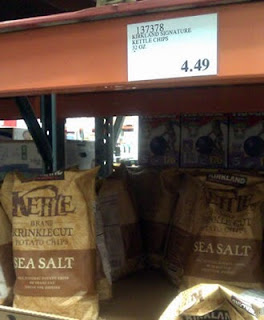
Gluten-Free Kettle Potato Chips
Gluten-Free Kettle Potato Chips in Bulk : 2# for $4.49!!

Gluten-Free Drink: Low-Sodium V8

Costco carries Low-Sodium V8 vegetable-juice in cases (28-count) for $13.99, or 50cents per 11.5-ounce can, which is not too shabby for a healthier alternative to sweetened soda or similar options. This vegetable juice does have a bit of added sugar that I would prefer they left out (as the sugars are pushed to 12g per can). There is a reasonable sodium level (200 mg) and a super-high potassium level to help counter any sodium (1180mg; boosted by their addition of potassium-chloride), and even 3grams of protein and 3grams of fiber (neither of which you will get from a standard soda!). In addition, Costco had a nice big COUPON for these recently where I saved multiple-dollars-per-case! Nice!

GF Non-Fat Yogurt: Fage Total 0% on the Cheap

Gluten-Free Non-Fat Fage Total Yogurt
Fage Total Zero-Percent-Fat Gluten-Free Yogurt (Kilo)
First of all, this is some really fantastic non-fat Greek yogurt! I mean to do a full "review" of this product, but in the mean-time, you can at least be aware of the Costco bargain price of $4.99 for 1-Kilo (33.8-ounce) Containers : a full 20-25% less than the best grocery-price I have found. This yogurt has a great thick and creamy consistency and makes a perfect start to many other self-created flavors of yogurt, and is also works well as a sour-cream alternative and more.

This Fage Total yogurt is loaded with protein too! A 1-cup serving (8-ounces) has only 130 calories, but yet packs a whopping 23-grams of protein into that serving; and, there are only 9-grams of carbs to accompany your mega-protein dose. This is a very diabetic-friendly product (or great for anyone watching their glycemic-index or blood-sugar), and if you make flavored yogurts of your own (starting with this product) and use something like Stevia for sweetening your creations, you can keep the sugar-levels super-low while getting 1/2 of your daily protein in one serving.

I have found this non-fat yogurt great for weight-loss and trimming some fat from my diet while keeping protein levels up (during weight-lifting and exercise too); the result has been a noticable reduction in overall body-fat levels and increased "toning" (note: again, I coupled this with *exercise* and weight-lifting... it is not a "magic" fat-loss remedy. sorry). You may get some benefit even without much workout effort if you find the yogurt as satisfying (to your appetite) as I do: it seems to "fill me up" for quite a while with low calories, and I presume the high-protein level helps with that. And, when combined with exercise, this stuff is just fantastic.

Gluten-Free Hummus in Bulk

Gluten-Free Sabra Hummis and Lentil Chips
Hummus and Lentil Chips : all gluten-free!
Sabra (brand) Hummus in large 1-Quart (yes, a LOT of hummus!) containers for only $5.99! I have seen tiny little 8-ounce containers of the same brand of hummus at regional grocery stores for nearly that same price... and, as much as I like hummus, I definitely can go through 4-times the hummus for roughly the same price. I love this stuff on tortilla chips, celery-sticks, carrots, and lentil-chips... which brings me to...

Mediterranean Snacks brand of cucumber-dill (flavor) Baked Lentil Chips: $5.89 for a big one-pound bag of these fantastic chips when they were recently being sold by Costco this summer. But, lately I have not seen a new supply come in to replace the last batch a few weeks ago. I HOPE they get them back in stock because they are wonderful tasting (perhaps slightly too much sodium, but otherwise good), low-calorie, and high in fiber.

A one-pound bag is rather large (in size) because the chips are very light and super crunchy (great texture, and they hold up to dipping in hummus, etc!). Being bean-flour-based (lentil, garbanzo, and adzuki beans) these crunchy gluten-free snack chips packed 3grams of fiber and 4grams of protein into a 110-calorie one-ounce serving (and, a serving is a full 22 chips, not just a few chips); and, 10% of your iron, plus only 3-grams of fat per serving! The chips are made in USA and clearly labeled gluten-free (right on the front cover). Please Costco, GET MORE of these! :)

Cheap Cinnamon

I have been purchasing Costco's own brand of Ground Cinnamon which is incredibly reasonable at a mere $2.65 for 10.7-ounces! Seriously! That is CHEAP for this wonderful Saigon Cinnamon, and I use it as a type of "flour" in my baking (including my frequent pancakes), so this saves me a fortune. I have no idea why cinnamon varies so much in price, but I have seen (in grocery stores) the same thing cost as much per ounce as this entire container costs. Savings: up to 90%! And, the printed expiration-dates are at least 2-years out, so there is no chance I will not use ALL of a container in time (in fact, I go through one every few months).

Gluten-Free Body-Wash

Yes, you read correct: body-wash that is labeled gluten-free. I am rather "set in my ways" when it comes to the products I use for soaps, shampoos, and such, but when I saw Costco's own Kirkland (brand) of citrus body wash with the GF-labeling, curiosity got the best of me. I unscrewed a cap at the store to see what it smelled like...it has a pleasing scent of orange and citrus. So, I figured why not... and got some.

The Gluten-Free Body-Wash comes in a dual-container package: i.e., (2) 27-ouce containers for $9.99. That is a lot of body wash. I really do not know how well the price compares since I do not know what to compare it to, but it seemed reasonable for just under 1/2-gallon of the product, and it has been lasting quite a while. I definitely like the noticeable smell of oranges, and it seems to do what it is supposed to: it cleans just fine.

Gluten-Free Fruits and Vegetables

Fresh fruit and veggies: although I did not list specific examples here, there are quite a few great money-saving deals on fresh vegetables (lettuce, carrots, celery, asparagus, spinach, tomatoes, etc) and fruits (raspberries, blackberries, cherries, strawberries, watermelon, apples, cantaloupe, honeydew, figs, bananas, oranges, grapefruit, etc) at Costco, and of course these are all great gluten-free diet options.

The prices generally beat the grocery store (substantially in many cases), but the prices vary considerably with the seasons and availability just like at any other store, so I did not provide specific cost-examples. I am rather sure that we save enough *just* on the fresh fruits and veggies every year at Costco to pay for the membership; that should give you a feel for what the savings can add up to.

More Gluten-Free Costco Bargains to Come...

This is the second installment of the Costco gluten-free products discussion. I plan to do more, as there are a lot of GF deals to still enumerate here (and products I really like). Stay tuned for the next list of bargains. I hope you have a Costco location near you so you too save you money on gluten-free products.  Also, there are more items listed on my prior blog here: Gluten-Free Food / Product Bargains at Costco in 2011.

Continue to read this Gluten-Free Blog for all sorts of gluten-free recipes, product-reviews, and related information. In addition, visit my Gluten-Free Recipes Site where many of the recipes I have featured on this blog are available.

Monday, August 29, 2011

Chocolate : Gluten-Free Healthy Diet Component

Chocolate in your Gluten-Free Diet for Improved Health

Chocolate as a preventative measure for cardiometabolic diseases

Thank God chocolate is gluten-free! I love chocolate, and it is nearly its own "food group" in my diet. And, chocolate is once again getting more attention from the medical and scientific community researching its potential to influence our health in a positive way. I have written about the health benefits of chocolate / cocoa here on the Gluten-Free Blog in the past, including this blog from just a year ago about how Dark Chocolate Lowers Blood Pressure. This latest research reinforces prior findings.

The BMJ (British Medical Journal) just published their research findings about chocolate in a paper titled "Chocolate consumption and cardiometabolic disorders: systematic review and meta-analysis". Those "disorders" looked at include cardiovascular disease (coronary heart disease and stroke), diabetes, and metabolic syndrome. And, chocolate consumption proved to be quite beneficial in reducing some symptoms of those diseases/disorders.

Chocolate Consumption leads to Substantial Reduction in Risk of Cardiometabolic Disorders

I for one do not require further encouragement to consume chocolate, but it is nice to know that my cocoa and chocolate addiction could at least help me maintain better overall health as part of my gluten-free diet. This particular study came up with the following Results/Conclusions (directly quoted excerpts from the BMJ article):

Chocolate Study Results

From 4576 references seven studies met the inclusion criteria (including 114 009 participants). None of the studies was a randomised trial, six were cohort studies, and one a cross sectional study. Large variation was observed between these seven studies for measurement of chocolate consumption, methods, and outcomes evaluated. Five of the seven studies reported a beneficial association between higher levels of chocolate consumption and the risk of cardiometabolic disorders. The highest levels of chocolate consumption were associated with a 37% reduction in cardiovascular disease (relative risk 0.63 (95% confidence interval 0.44 to 0.90)) and a 29% reduction in stroke compared with the lowest levels.

Chocolate Study Conclusions

Based on observational evidence, levels of chocolate consumption seem to be associated with a substantial reduction in the risk of cardiometabolic disorders. Further experimental studies are required to confirm a potentially beneficial effect of chocolate consumption.

Getting more Chocolate in your Gluten-Free Diet

If you want to bump-up the amount of chocolate in your gluten-free diet in hopes of obtaining some of those same beneficial results, how can you best go about that? First of all, keep in mind that the benefits shown in these studies can be offset by the negative effects of consuming too many calories, too much fat, too much sugar, and so on.

Next, keep in mind that it is the COCOA that is apparently providing the health benefits through its polyphenol content and anti-oxidants — thus, plain cocoa is going to provide the most health benefit for the buck, followed by dark chocolate. Keep in mind that many forms of chocolate (like milk chocolate) will contain saturated fats that are certainly not "healthy". So, my personal opinion is that you should find ways to primarily consume cocoa without all the added fats, sugars, and such.

Sure, I am going to get my cocoa in my gluten-free chocolate cakes, cookies, and so forth, but I get most of my cocoa in frequently-consumed healthier creations like my near-daily gluten-free pancakes (where I use a LOT of cocoa), and in my homemade chocolate smoothies (again, much cocoa) just to name a couple.  Cocoa is a rather versatile ingredient, and it makes a great gluten-free "flour" from my experience (high in fiber and even some minerals).

See my prior blog for links to various Gluten-Free Recipes using cocoa : including diet-shakes that I have posted online.  That chocolate-chia-seed-pumpkin-spice "milkshake" (its actually dairy-free) is one great way to get a low-cal cocoa-enhanced flavorful summertime treat (note: I personally use a lot more cocoa than the "normal" amount shown in the recipe; I also use unsweetened rice-milk or hemp-milk and add a packet or two of PureVia stevia for sweetness to keep the sugar down).

Enjoy your cocoa!

Continue to read this Gluten-Free Blog for all sorts of gluten-free recipes, product-reviews, and related information. In addition, visit my Gluten-Free Recipes Site where many of the recipes I have featured on this blog are available.

Monday, August 15, 2011

Lower triglycerides with Spices

Spice-Up Your Gluten-Free Diet and Lower your Triglycerides

The Health-Benefits of Common Spices

I was just reading an interesting publication from the Journal of Nutrition wherein Penn State researchers were reporting their observations regarding the effects of a High Antioxidant Spice Blend (in one's diet) and how these significant amounts of various common spices could reduce the typical post-meal Insulin and Triglyceride responses while increasing antioxidants too, particularly when added to a high-fat meal.

Lowering triglycerides is certainly a good thing, since high levels of triglycerides (in your blood) are linked to atherosclerosis (hardening of the arteries) which increases the risk of heart disease and stroke. And, since humans are "hard wired" to enjoy the taste of high-fat meals, if it could be as simple as adding some significant doses of culinary spices to our gluten-free diets to help lower our triglycerides, I am all for it.

Which Spices, and How Much Spice?

This particular study was not done using gluten-free foods, but that should not matter since the only difference between the "control" group and the "spice" group was just the spices — implying that it is only the spices that account for the observed reduction in insulin and triglyceride responses:
"The researchers added two tablespoons of culinary spices to each serving of the test meal, which consisted of chicken curry, Italian herb bread, and a cinnamon biscuit. The control meal was identical, except that spices were not included." 
All of the spices used within this study are generally what I would consider "mainstream" spices — though turmeric would be the one spice I would more closely associate with Indian and/or middle-eastern cuisine, and cloves are used rather sparingly in Western dishes too from my experience (clove can quickly overwhelm other flavors). Here are the spices that were used in the study:
"In the spiced meal, we used rosemary, oregano, cinnamon, turmeric, black pepper, cloves, garlic powder and paprika,"
If one considers all the possibilities for using such spices, many wonderful and tasty main dishes, appetizers, desserts, and even drinks come to mind. I use a LOT of cinnamon in my daily gluten-free buckwheat pancakes for example, and I enjoy making Chai Tea with Cinnamon, Cloves, and even a bit of black pepper (plus Cardamon and other complementary spices). I like turmeric, garlic, black pepper, and paprika in dishes ranging from potato salad to quinoa/rice dishes to the chicken curries (mentioned in the article).  There are many, many tasty dishes where these spices could be used to produce fantastic flavor-filled meals.

My only concern in reading this article was related to the amount of spices the researchers used: two tablespoons.  The didn't give a breakdown of how much of each spice was used, but my first thought is how I can consume a LOT of spices like cinnamon, garlic, and black pepper, but I use relatively little oregano, paprika, clove, and turmeric due to their relative "strength" (flavor-wise) in dishes.  I can consume two tablespoons of cinnamon in one batch of my pancakes, but I can hardly dream up a way to consume (in an enjoyable fashion) two tablespoons of clove at once :)

Results: Substantially Lower Triglycerides and Lower Insulin Response

The results were rather significant and encouraging:
"We found that adding spices to a high-fat meal reduced triglyceride response by about 30 percent, compared to a similar meal with no spices added."

Wow, 30 percent lower just from the addition of these spices!  That is certainly noteworthy. If you want to read more details, you can find the original article here I would definitely like to see some other studies confirm these results in the coming months and years.  You would think it would be very easy to do so, since the study sounded quite simple to duplicate

The results went further too:
When the meal contained a blend of antioxidant spices, antioxidant activity in the blood was increased by 13 percent and insulin response decreased by about 20 percent
The insulin-response numbers alone should be getting the attention of any researchers studying diabetes / blood-sugar conditions and treatments.  20% is a substantial number for sure.

So, whether or not spices produce this desirable lowering of triglycerides in your gluten-free diet or not, it sounds like an easy enough change to consider working into your meal program.  The cost of spices may be semi-prohibitive, but if it could offset medical costs, I'd personally choose investing in spices.  I am working on ways to add more of these spices to my own gluten-free foods on a daily basis, and it is mainly just the turmeric, paprika, and clove that I do not regularly consume, so my changes should be minimal.

Continue to read this Gluten-Free Blog for all sorts of gluten-free recipes, product-reviews, and related information. In addition, visit my Gluten-Free Recipes Site where many of the recipes I have featured on this blog are available.